

Why Controlling Overhead Starts with Smarter Supply Purchasing
Reduce dental supply costs and you immediately impact your practice's bottom line. Here's how to do it effectively:
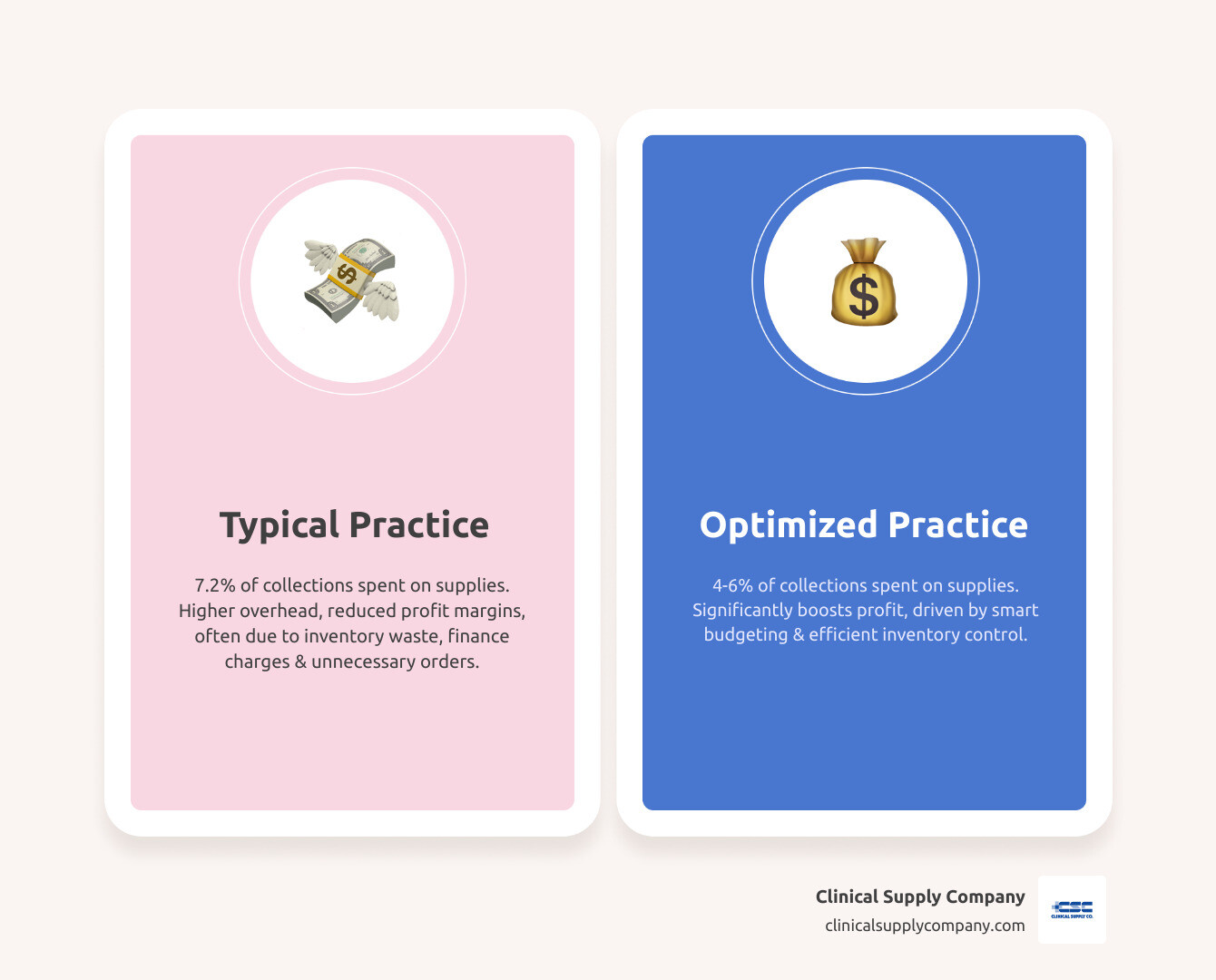
- Set a strict budget - Aim for 4-6% of collections on supplies, not the average 7.2%
- Audit inventory monthly - Identify waste, expired products, and overstocking
- Apply the 80/20 rule - Focus on your most-used 20% of supplies
- Centralize storage - Stop hidden stashes that lead to duplicate orders
- Build supplier relationships - Negotiate better terms with dedicated partners
- Test before buying - Use samples to evaluate cost-effective alternatives
- Leverage technology - Use procurement software to compare prices and track spending
- Train your team - Get everyone involved in cost-conscious purchasing
- Consider a GPO - Join a group purchasing organization for collective buying power
- Minimize waste - Choose reusable products where clinically appropriate
The cost of just about everything is rising, and dental supplies are no exception. While the average single practice spends 7.2% of collections on supplies according to an Aldrich report, dental supplies don't have to be your second-largest expense after payroll. With strategic planning, you can protect your profit margins while maintaining quality care.
While supply chain disruptions and inflation make cost control feel overwhelming, a systematic approach to supply management can reduce overhead by 5-7%. The difference between the average 7.2% spend versus the ideal 4-6% can mean tens of thousands of dollars in recovered profit annually.
I'm Adam Schuh, President and CEO of Clinical Supply Company. I've spent years helping dental practices steer supply chain challenges with data-driven approaches to cost control. My experience has proven that strategic supply management is one of the most powerful tools for protecting your bottom line. I'm committed to helping you reduce dental supply costs without compromising patient safety or practitioner comfort.
Master Your Finances: Budgeting and Auditing

To reduce dental supply costs, you must start with the fundamentals: knowing exactly where your money is going. While not the most exciting part of dentistry, financial planning is essential for a healthy, profitable practice. After payroll, dental supplies are typically your largest variable expense. With national average overhead around 65%, controlling supply costs is one of the most powerful levers for protecting your profit margins.
Another financial drain to watch for is finance charges from carrying credit balances. Paying interest on supplies because of delayed payment silently erodes your profitability. Settling invoices promptly puts that money back in your pocket.
Tip 1: Create a Data-Driven Supply Budget
A robust supply budget isn't about restriction; it's about making informed decisions that improve profitability. It creates guardrails to keep your spending on track.
The sweet spot for supply spending is between 4% and 6% of your collections. While an Aldrich report shows the average is 7.2%, top-performing practices operate in the 4-6% range, as suggested by the American Dental Association. A well-defined budget gives you tracking power to spot trends and adjust before small issues become big problems. Set specific goals based on your collections data, then track spending against those benchmarks monthly. For detailed guidance, the ADA offers excellent resources on How to Budget Better for Dental Supplies.
Tip 2: Conduct Regular Supply Audits
A budget only works with verification. That's where regular supply audits become your best friend. Aim for monthly or at least quarterly audits—consistency is key. Your audit should use a thorough inventory checklist to capture everything on hand.
The goal is to identify expired products, spot unused supplies tying up capital, and uncover hidden stashes that lead to duplicate orders. One of the most valuable metrics from your audit is your wastage rate (damaged, expired, or spoiled items). Calculating this regularly reveals patterns, such as which products consistently expire before use, allowing you to make data-driven ordering decisions. A comprehensive audit ensures your budget aligns with your actual usage. Learn more in our guide on efficient inventory tracking.
You can't manage what you don't measure. Regular audits provide the visibility needed to reduce dental supply costs systematically.
Optimize Your Operations: Smart Inventory Control

With a budget and audit schedule in place, the next step is optimizing daily inventory management. Poor organization—scattered supplies, expired products, or mismatched order quantities—means money walking out the door. The goal is simple: have what you need when you need it, without tying up cash in excess inventory or creating waste. Smart inventory control prevents both panic orders and the frustration of finding duplicate stock.
Tip 3: Apply the 80/20 Rule to Your Ordering
The Pareto Principle applies to your inventory: roughly 20% of your products account for 80% of your usage, as explained by Investopedia's 80-20 rule. Applying this insight is a powerful way to reduce dental supply costs.
Identify your essential 20%—high-frequency items like gloves, masks, and anesthetic—and establish a monthly ordering cycle for them. You'll know exactly how much your practice uses in 30 days, so you order just that amount. For less frequently used items, maintain smaller stock levels and order as needed. This strategy prevents overstocking (which ties up cash) and reduces the risk of products expiring. For more on this, the American Dental Association provides practical guidance on inventory control.
Tip 4: Centralize Storage and Eliminate Hidden Stashes
Does this sound familiar? Your office manager orders supplies, only to find a hidden stash in an operatory two days later. These hidden stashes are an inventory management nightmare, leading to unnecessary orders, inaccurate counts, and waste. An assistant's personal supply, while well-intentioned, creates a blind spot in your system.
The solution is to centralize storage in a single, well-organized location. When team members need supplies, they retrieve them from the central closet. This gives you accurate inventory counts at a glance and makes implementing the first-in-first-out (FIFO) method simple. By using older stock first, you dramatically reduce waste from expired products. One practice we work with saved over $8,000 in their first year just by consolidating their supply system.
Tip 5: Leverage Technology for Efficient Tracking
If you're still using spreadsheets to manage inventory, you're working too hard. Procurement software and digital procurement platforms have transformed how practices track supplies and control costs.
These tools offer capabilities manual systems can't match, including price comparison tools that let you evaluate costs across vendors in seconds. They streamline ordering, freeing up staff to focus on patient care. Most importantly, they provide real-time visibility into spending, allowing you to compare against your budget and identify trends instantly. Some platforms even integrate with practice management software to suggest reorder points based on historical usage.
We've seen practices reduce their supply spend as a percentage of revenue by 25% after implementing procurement technology. Tracking spending against budget becomes effortless when the software does the work. This level of visibility is what separates practices that hit their 4-6% supply cost target from those that don't. Learn more about leveraging technology for your practice.
Strategic Sourcing to Reduce Dental Supply Costs

Strategic sourcing isn't just finding the cheapest product. It's a thoughtful process of evaluating suppliers, negotiating effectively, and balancing quality with cost. Successful practices treat purchasing as a strategic function, not just an expense. Many practices fall into the trap of complacency, ordering from the same supplier for years. But is "fine" good enough for your second-largest expense? The supply landscape changes constantly, so regularly re-evaluating your suppliers is crucial for long-term cost efficiency.
Tip 6: Build Strong Supplier Relationships
View your supply partner as an extension of your team. A genuine, long-term relationship yields benefits beyond a catalog, like better pricing, flexible payment terms, and customized solutions. At Clinical Supply Company, we've built our business on this philosophy. We provide dedicated sales representatives who offer personalized service, a distinct advantage over mega-distributors like Henry Schein, where you might get lost in automated systems or deal with rotating account managers.
Our representatives are knowledgeable partners who understand your practice's workflows and goals. They help identify cost-saving opportunities, guide product choices, and troubleshoot issues. When you need advice, you have someone who knows your practice and cares about your success. Learn more about the value of sales representatives.
Tip 7: How to effectively reduce supply wastage
Smart product evaluation is your first defense against waste. Use free samples from suppliers to let your clinical team test products in real-world scenarios without financial commitment. This helps you evaluate if a less expensive alternative performs well or if a premium option justifies its price.
Once you've identified quality, cost-effective products, create a formulary—your practice's custom catalog of approved supplies. Involving your clinical team in this selection process ensures buy-in and compliance. Brand consolidation is where the real savings begin. By reducing the number of SKUs you stock and focusing your purchasing on fewer brands, you can negotiate better volume pricing. The key is to never sacrifice quality for cost. A cheap product that leads to inferior clinical results is not economical. Our commitment is to provide top quality dental supplies that meet your clinical needs without breaking your budget.
Tip 8: Consider Joining a Group Purchasing Organization (GPO)
For smaller practices, a Group Purchasing Organization (GPO) is a powerful way to reduce dental supply costs. GPOs leverage the collective buying power of many practices to negotiate better prices, giving you access to volume discounts you couldn't get alone. Practices report savings of up to 20% on their overall supply costs.
These savings extend across numerous categories, including disposables, sterilization products, impression materials, imaging solutions, and even CAD/CAM technology. While our strong relationships at Clinical Supply Company already ensure competitive pricing, a GPO can be another layer in your cost-reduction strategy. Many successful practices use both approaches, combining the personalized service of a dedicated supplier with the volume discounts of a GPO.
In-Office Strategies for Daily Savings

Even the best purchasing strategy will fail if your team isn't on board. Cost reduction requires a culture where everyone understands their role in protecting the practice's financial health. Your team members are on the front lines, making dozens of small decisions daily that either save money or waste it. Fostering team collaboration transforms supply management from a burden into a shared responsibility.
Tip 9: How to effectively reduce dental supply costs through waste management
Minimizing waste is a direct path to reducing dental supply costs without changing a single vendor. It starts with understanding where waste occurs and taking steps to prevent it.
Urgent orders are a key source of waste. When you run out of a critical item, you pay premium shipping fees that can double or triple its cost. Proper planning and inventory management eliminate these emergencies. Also, consider the reusable versus disposable debate. While convenient, disposables aren't always the most economical. In some cases, an upfront investment in high-quality, sterilizable instruments can pay for itself over time by reducing the need for single-use items.
Sterilizable instruments also deserve attention. High-quality instruments cost more initially but last far longer, reducing replacement frequency. Finally, employee training is critical. Your team must understand proper usage protocols, like how much material to dispense and how to store products correctly. Small amounts of over-dispensed material add up to thousands of dollars wasted annually.
Tip 10: Involve and Train Your Entire Team
Your best software and supplier contracts are useless without team buy-in. Employee involvement and training are the foundation of sustainable cost control. Start by educating your team on the financial impact of supply costs on the practice's ability to invest in equipment and salaries. When team members see themselves as contributors, their mindset shifts.
Train everyone on procurement processes so they know who can order, what the approval process is, and which products are on the formulary. This prevents rogue spending and expensive urgent orders. Foster a cost-saving mindset by encouraging your team to identify waste and suggest improvements. Your clinical staff often has the best insights.
Assigning an inventory manager creates clear accountability for ordering, audits, and vendor relationships. Finally, reward efficiency. Acknowledging a cost-saving idea in a team meeting can be powerful motivation. When your team sees that efficiency is valued, they become active partners in helping to reduce dental supply costs.
Frequently Asked Questions about Reducing Dental Supply Costs
What percentage of revenue should a dental practice spend on supplies?
A healthy practice should aim to spend between 4% and 6% of its collections on dental supplies. The national average is higher—around 7.2% according to an Aldrich report. For a practice collecting $1 million annually, that 1-3% difference means $12,000 to $32,000 in lost profit that could be reinvested in the practice. Controlling this expense is key to managing your overall overhead of 65% or less.
How can my practice save money without sacrificing quality of care?
This is about strategic sourcing, not just buying the cheapest products. Build a relationship with a reliable supplier like Clinical Supply Company for personalized recommendations that balance cost and quality. Use free samples to let your clinical team test cost-effective alternatives before committing to a bulk order. Finally, create a formulary of approved, high-quality items to standardize care and leverage volume pricing. The best value comes from products that perform reliably, reduce chair time, and minimize do-overs.
What is the single biggest non-payroll expense for a dental practice?
After staff wages, dental supplies are often the most significant variable expenditure for an independent practice. This makes managing them a critical lever for improving profitability. Because supply costs are variable, you have real power to improve your bottom line through smarter management. This is why we've focused on strategies to reduce dental supply costs—implementing even a few can transform this major expense into a well-managed part of your operation.
Boost Your Bottom Line with Smarter Supply Management
This roadmap, from budgeting and auditing to building supplier relationships and empowering your team, offers a path to lasting financial health for your practice. The difference between spending 7.2% of collections on supplies versus the ideal 4-6% can mean tens of thousands of dollars back in your pocket each year. This isn't about buying cheaper products; it's about eliminating waste and creating systems that protect your profit margins.
Long-term cost efficiency comes from consistency. The practices that successfully reduce dental supply costs make these strategies part of their daily operations. When your team understands the financial impact of their choices and you have reliable systems, cost control becomes second nature.
At Clinical Supply Company, we've built our reputation on understanding what dental practices need. As a Midwest-based national dental supply company, we're not a faceless mega-distributor. We're your neighbors in Ohio, committed to providing the personalized service your practice deserves. Our dedicated sales representatives understand your needs, help you find cost-saving opportunities, and ensure you never compromise on quality.
We know navigating the supply chain can be overwhelming. That's why we've made it our mission to be your reliable partner—someone invested in your success. When you work with us, you get more than just products; you get a partner who understands that every dollar saved on supplies strengthens your practice.
Ready to take the next step? [Learn more about what to consider when buying dental supplies online] and find how Clinical Supply Company can help you achieve your financial goals while maintaining exceptional quality of care.
Posted by Adam Schuh Last Updated February 2026 President, Clinical Supply Company