

Why a Solid Dental Office Budget is Your Practice's Foundation
Dental office budget planning is the difference between a thriving practice and one that struggles despite seeing plenty of patients. A strategic budget provides a clear path forward, turning financial uncertainty into a predictable future where every dollar is accounted for.
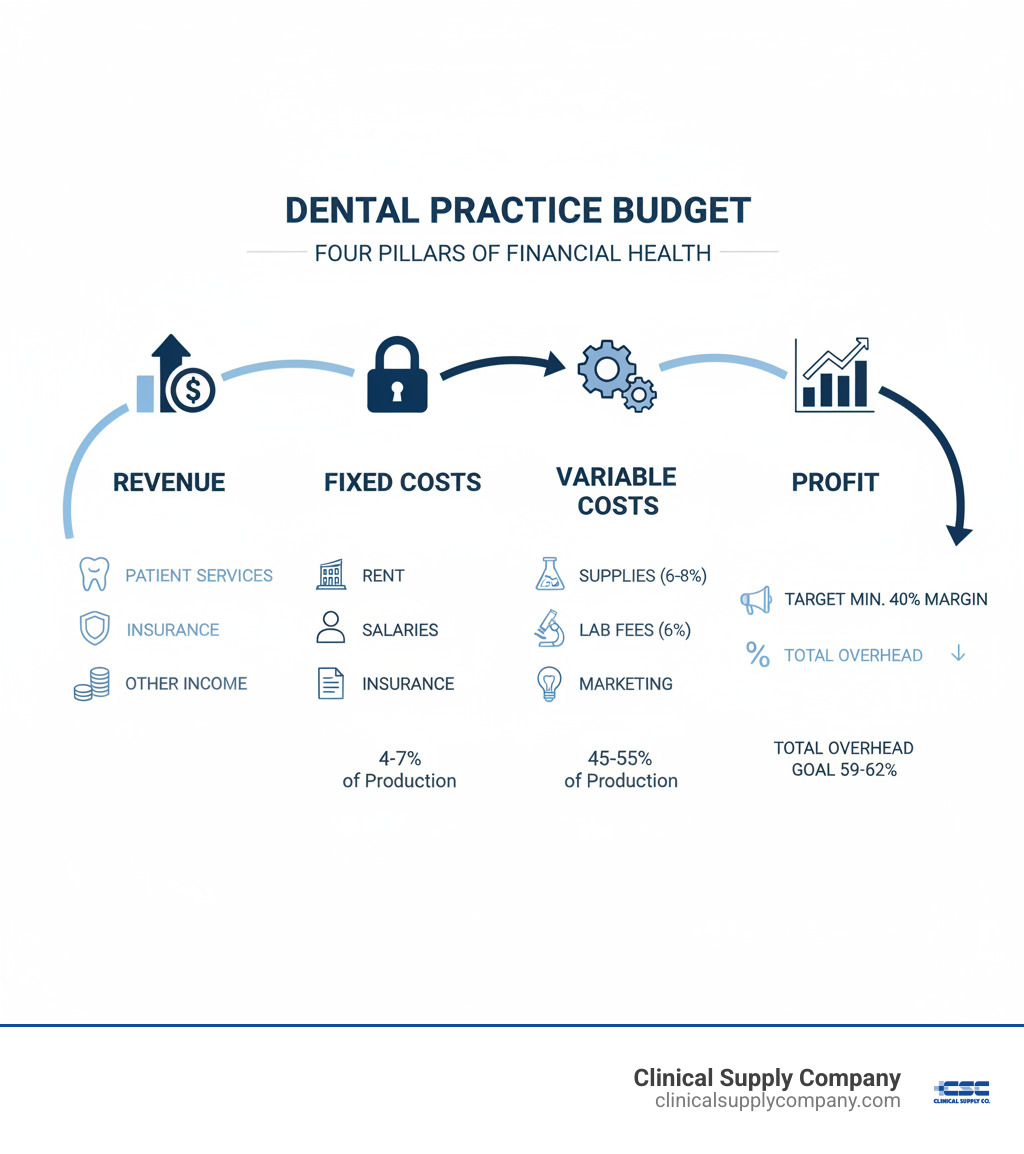
Key Components of a Dental Office Budget:
- Revenue Projection - Estimate income from patient services, insurance reimbursements, and other sources
- Fixed Costs (4-7% of production) - Rent, insurance, salaries, utilities
- Variable Costs (45-55% of production) - Supplies, lab fees, marketing, equipment maintenance
- Target Overhead - Keep total expenses between 59-62% to maintain healthy profit margins
- Profit Margin - Aim for minimum 40% to ensure financial stability
The reality is stark—according to a 2023 ADA survey, expenses (including shareholder salaries) totaled 97.7% of gross billings collected for general dentists. That leaves very little room for error. The average dental practice generates about $800K in revenue annually, but most need around $600,000 just to break even. A budget helps ensure that revenue doesn't slip through the cracks.
A comprehensive budget isn't about restricting spending; it's about making strategic decisions. It means knowing your fixed costs (like rent) from your variable costs (like supplies), tracking your overhead, and planning for the unexpected.
I'm Adam Schuh, President and CEO of Clinical Supply Company. I've spent years helping dental practices steer supply chain challenges that directly impact their dental office budget. I've seen how smart budgeting for essential supplies can make or break a practice's financial health.
Understanding Your Practice's Financial Landscape

Before building a solid dental office budget, you must understand your practice's financial landscape. Whether you're opening a new practice or buying an existing one, a firm grasp of startup costs and ongoing expenses is the foundation of financial success.
Estimating Startup Costs for a New Practice
Opening a dental practice is a major financial commitment, with estimated startup costs ranging from $625,000 to $1,250,000. Alternatively, buying an existing practice costs about $520,000 on average, typically based on 65% of the previous year's gross receipts.
Key startup investments include:
- Real Estate: A 2,000-square-foot office is a common starting point. Construction and finishing can cost around $120 per square foot ($240,000 total), with monthly rents in Midwest cities like Columbus or Cincinnati ranging from $5,000 to $8,000.
- Dental Equipment: This is a major expense, with specialized equipment like X-ray machines and sterilization units pushing costs into the mid-six-figures. Leasing high-cost items can reduce initial setup expenses by up to 20%.
- Technology: Expect an initial investment of $30,000 to $70,000 for digital X-ray systems, electronic health records, and practice management software.
- Licenses and Permits: These non-negotiable legal requirements typically cost between $5,000 and $10,000.
- Initial Inventory: Stocking your operatories requires a significant outlay for supplies. Clinical Supply Company helps you manage these initial costs efficiently without compromising quality. You can learn more on essential supplies for your office to get started.
For a detailed guide, the American Dental Association (ADA) checklist for new practices is an excellent resource.
Breaking Down Operating Expenses
Once operational, your practice will have ongoing fixed and variable costs. The average overhead for a dental office is about 62%, with monthly overhead typically ranging from $30,000 to $50,000.
Fixed costs remain constant regardless of patient volume:
- Rent/Lease Payments: Typically $5,000 to $10,000 monthly.
- Staff Salaries: Your largest fixed cost, comprising 25-30% of total expenses.
- Insurance Premiums: Malpractice, property, and liability insurance usually range from $2,000 to $5,000 annually.
- Software & Loan Payments: Subscriptions can run $200-$500 monthly, with loan payments adding another $1,000-$3,000.
Variable costs fluctuate with practice activity:
- Clinical Supplies: A significant variable cost, averaging 7.6% of collections or 6-8% of revenue. Partnering with a reliable supplier like Clinical Supply Company helps manage these costs effectively.
- Lab Fees: Typically 10-14% of overhead, or about 5.8% of collections, for outsourced work like crowns and bridges.
- Utilities & Marketing: Utilities can range from $1,000-$2,000 monthly, while marketing costs often fall between $1,000-$3,000 monthly.
- Maintenance & Repairs: Budget an average of $500 to $1,500 monthly for equipment and facility upkeep.
Understanding these financial fundamentals is about building a practice that can weather challenges, invest in growth, and provide you with long-term financial stability.
How to Create a Comprehensive Dental Office Budget

Creating a comprehensive dental office budget is about building a financial roadmap that guides your practice toward its goals. It's the tool that helps you control your finances and make strategic decisions for growth.
Projecting Revenue and Expenses Accurately
A solid budget begins with accurate projections. For established practices, your historical financial statements are invaluable. Analyze past trends in patient visits, procedure revenue, and collection rates. For new practices, research your local market and demographics to create realistic projections for patient acquisition.
Your revenue forecast must account for patient volume, your payer mix (PPO, Medicaid, self-pay), and realistic collection rates. With the average practice needing to generate around $600,000 of its $800,000 in annual revenue just to break even, every percentage point in collections matters. Regularly review your fee schedules to ensure they are competitive and support your overhead. For reliable salary data when planning, the Bureau of Labor Statistics for salary data provides current wage information.
On the expense side, separate predictable fixed costs like rent from variable costs like clinical supplies and lab fees. Review past spending and adjust forecasts for any planned changes, such as hiring new staff or adding services.
Developing Your Dental Office Budget Strategy
A budget strategy connects your financial plan to your practice's vision. Start by setting SMART goals (Specific, Measurable, Achievable, Relevant, Time-bound). For example, instead of "save money," aim to "reduce clinical supply costs by 8% in six months through better inventory management."
Distinguish between short-term goals, like building cash reserves, and long-term goals, like investing in new technology. A crucial part of any strategy is a contingency fund. We recommend setting aside a 5% to 10% buffer in your budget for unexpected expenses like equipment repairs or supply cost fluctuations. This financial shock absorber prevents small bumps from becoming major crises.
Align your budget with your practice vision. If a premium patient experience is your goal, allocate funds for technology and comfort. Involve your dental team in the process; their daily operational insights are invaluable for creating a realistic budget. While you can use software to create a budget, consider seeking expert guidance from a CPA or financial advisor specializing in dental practices. They can provide strategic tax planning and industry-specific insights. The ADA guidelines for developing business plans also offer excellent insights for budget development.
At Clinical Supply Company, we help you manage variable costs by providing predictable supply pricing without sacrificing quality, ensuring your budget strategy has a reliable partner.
Optimizing Your Budget for Maximum Profitability

Once your dental office budget is in place, the goal is to optimize it for maximum profitability. This means making smart decisions that improve your bottom line while maintaining high-quality patient care.
Managing and Reducing Operating Costs
Industry benchmarks suggest overhead costs should be between 59% and 62% of your revenue. The average dental office is around 62%. If your overhead is higher, there are several areas to optimize.
Supplier negotiation and inventory management offer a significant opportunity for savings. As your largest variable cost after salaries, supply expenses require strategic management. At Clinical Supply Company, we provide competitive pricing and consistent quality. As a Midwest-based national supplier, we offer the personalized service of a small business with the capabilities of a large distributor. Our one-stop-shop approach streamlines purchasing and helps you implement efficient inventory practices, saving you time and money. Learn about The CSC Small Business Benefit and What to Consider When Buying Dental Supplies Online.
Other cost-saving measures include outsourcing tasks like billing and insurance verification to reduce administrative burden, negotiating your lease for better terms upon renewal, and optimizing staffing with cross-training and part-time hires to match patient flow.
Leveraging Technology to Boost Efficiency
The right technology can reduce your dental office budget over time by increasing efficiency.
Practice management software is essential, but it's important to choose the right system. Many practices find that complex software from large providers like Henry Schein leads to paying for bloated bundles and features they don’t use. This is the opposite of the value-focused approach we champion at Clinical Supply Company. Select a system that fits your workflow and budget to avoid overpaying, and ensure your team is fully trained to use it.
CRM and marketing automation tools can handle appointment scheduling, invoicing, and patient communication, freeing up your team for higher-value tasks. Digital imaging and CAD/CAM technology, despite the upfront cost, can dramatically reduce ongoing lab fees by allowing you to create prosthetics in-house. Emerging AI tools also show promise in improving diagnostic accuracy and streamlining workflows.
Strategies to Improve Your Practice's Profit Margin
Your goal should be a minimum profit margin of 40%. If you're falling short, focus on both increasing revenue and controlling costs.
- Analyze and update your fee schedules annually to ensure they are competitive and reflect your costs.
- Focus on offering and promoting profitable procedures that align with your skills and patient needs.
- Improve patient retention with modern conveniences like online scheduling and effective communication systems.
- Systematize your collection process. Provide written financial estimates, offer multiple payment options, verify insurance before treatment, and collect co-pays at the time of service. A strong front-desk process is critical to preventing revenue leaks.
By combining controlled expenses with strategic revenue growth, you create a healthier, more sustainable practice. For more guidance, see More on navigating dental success.
Maintaining Financial Health: Budget Reviews and Tax Planning
Think of your dental office budget as a living document, not something you create once and file away. Your practice's financial health requires consistent monitoring and care, just like your patients.
How Often to Review and Adjust Your Dental Office Budget
Successful practices treat budgeting as an ongoing process. A structured review schedule helps you stay proactive rather than reactive.
- Monthly Reviews: This is your financial pulse check. Quickly review income and expenses to catch issues early, like a spike in supply costs or lagging collections.
- Quarterly Adjustments: Take a deeper dive to compare your actual results against your budget projections. This is the time to make tactical adjustments, like reallocating marketing spend or addressing higher-than-expected lab fees.
- Annual Overhauls: Once a year, conduct a comprehensive budget review to incorporate big-picture changes like new services, major equipment investments, or team expansion. This is when you set fresh SMART goals for the year ahead.
Beyond the budget itself, track key performance indicators (KPIs) like production vs. collections, overhead percentage (aiming for 59-62%), accounts receivable aging, and unpaid insurance claims. These metrics provide a complete picture of your financial health. For more tips, the Dental practice budgeting basics article offers excellent guidance.
Key Tax Write-Offs and Deductions for Dentists
Smart tax planning is an essential part of your financial strategy. Understanding your deductions is like finding money you didn't know you had. Always work with a CPA specializing in dental practices, but here are some key deductions to be aware of:
- Salaries and Wages: All compensation paid to your team, including bonuses and benefits, is fully deductible.
- Equipment Purchases: Section 179 deductions and bonus depreciation often allow you to deduct the full cost of new equipment in the year of purchase.
- Clinical and Dental Supplies: Everything you order to keep your practice running—from gloves and masks to sterilization products—is a fully deductible business expense. Partnering with Clinical Supply Company provides clear documentation that simplifies this process at tax time.
- Administrative Costs: Rent, utilities, office supplies, software subscriptions, insurance, and marketing expenses are all deductible.
- Professional Development: Continuing education courses, professional memberships (like ADA dues), and license renewals are deductible investments in your career.
- Malpractice Insurance: Your premiums are a necessary and fully deductible business expense.
For a more detailed list, the Cost Breakdown of Dental Office Expenses offers valuable insights. Proactive tax planning is a year-round activity that optimizes your practice's financial efficiency.
Frequently Asked Questions about Dental Office Budgets

We've heard countless questions from dental professionals about their budgets. Here are answers to the most common ones.
What is a healthy overhead percentage for a dental practice?
A healthy overhead percentage for a dental office budget is between 59% and 62%, according to the American Dental Association. This figure includes all operating costs—salaries, rent, supplies, lab fees, and more—before the owner's compensation. If your overhead is consistently above 62%, it's a sign that you need to analyze your expenses and find areas for optimization.
How much should I budget for dental supplies?
Most dental practices should budget between 6% and 8% of their revenue for clinical supplies. For a practice generating $800,000 annually, this equals $48,000 to $64,000 per year. This percentage can vary based on your procedure mix and patient volume. Smart inventory management and supplier negotiation are key to staying within this benchmark.
This is where Clinical Supply Company provides significant value. We offer competitive pricing on high-quality products, helping you control this major variable cost. Our goal is to be your strategic partner, ensuring you can save on supplies without ever sacrificing quality or safety, which directly improves your bottom line.
Can I create a budget myself, or do I need a professional?
You can absolutely create a dental office budget yourself using accounting software like QuickBooks or various available templates. This approach can work well if your practice finances are straightforward.
However, a dental-specific CPA or financial advisor brings a level of industry expertise that is difficult to replicate. They understand complex issues like equipment depreciation, healthcare-specific tax advantages, and strategic compensation planning. While you can handle the basics, a professional can optimize your financial strategy, spot hidden opportunities, and help you steer major financial decisions. As your practice grows, their guidance becomes invaluable, freeing you to focus on patient care.
Conclusion
Your dental office budget is the backbone of a thriving, sustainable practice. It transforms daily operations into a strategic journey toward professional success and financial stability.
We've covered the essentials: understanding your costs, creating accurate projections, optimizing for profitability, and maintaining financial health through regular reviews. The reality is that with expenses totaling 97.7% of gross billings for many dentists, according to a 2023 ADA survey, proactive management of your dental office budget is not optional—it's essential.
One of the biggest opportunities for optimization lies in managing variable costs like clinical supplies. This is where a reliable partner makes all the difference. At Clinical Supply Company, we've built our business around being your one-stop shop. We offer competitive pricing on a comprehensive selection of high-quality products, backed by the exceptional service of a partner who genuinely cares about your success.
When you work with us, you're not just ordering from another supplier; you're partnering with a team committed to helping you control costs without compromising the quality of care your patients deserve. Your budget is a living document, and we're here to help you strengthen it.
Ready to simplify one of your biggest variable expenses? Explore our dental supplies and see how Clinical Supply Company can help you stock up smart and stay on budget. Check out Stock Up Smart: The Ultimate Resource for Wholesale Nitrile and Dental Gloves to learn more.