

Why Dental Glove Compliance Matters in Ohio
Dental gloves Ohio practices use must meet strict state regulations to protect both patients and staff. If you're running a dental office in Ohio, here's what you need to know right now:
Key Ohio Dental Glove Requirements:
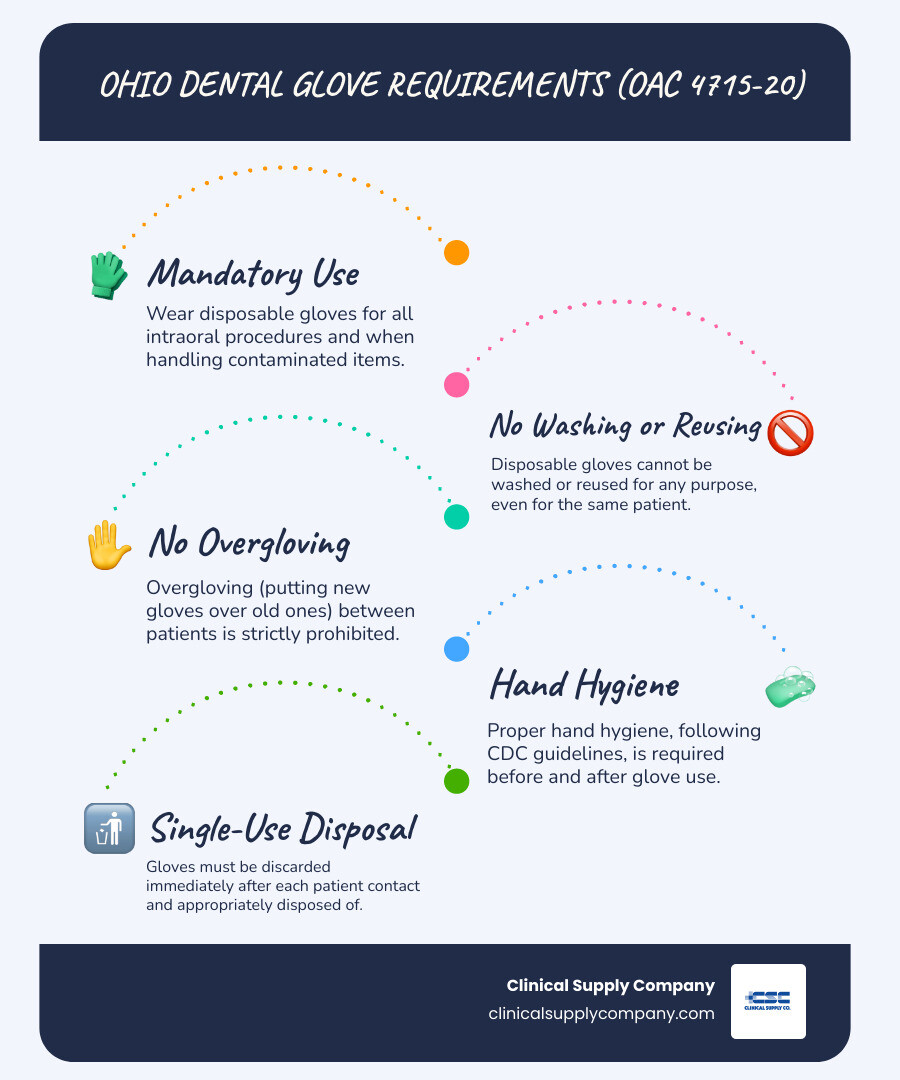
- Mandatory Use - Wear disposable gloves whenever placing fingers in a patient's mouth or handling blood/saliva contaminated items
- Never Reuse - Disposable gloves cannot be washed or reused for any purpose
- No Overgloving - Overgloving between patients is prohibited
- Proper Hand Hygiene - Follow CDC guidelines before and after glove use
- Single-Use Only - Gloves must be discarded after each patient contact
These rules come directly from Ohio Administrative Code Chapter 4715-20, which governs patient and personal protection in dental settings. Violation of these regulations can result in disciplinary action from the State Dental Board.
The good news? Compliance is straightforward when you understand the rules and choose the right gloves for your practice. Ohio has several local manufacturers and suppliers making it easier than ever to source quality gloves that meet regulatory standards.
I'm Adam Schuh, President and CEO of Clinical Supply Company, where I've spent years helping Ohio dental practices steer supply-chain challenges and regulatory requirements for dental gloves Ohio clinics depend on. My team and I work directly with dental professionals across the state to ensure compliance while maintaining cost-effectiveness and quality standards.
Understanding Ohio's Mandatory Glove Regulations
When you're running a dental practice in Ohio, understanding the rules around gloves isn't just about doing things right—it's the law. The Ohio Administrative Code (OAC) Chapter 4715-20 spells out exactly what dental professionals need to do when it comes to personal protective equipment, with a particular focus on dental gloves Ohio practices must use every single day.
These regulations aren't arbitrary rules dreamed up in a vacuum. They're built on solid infection control principles developed by the Centers for Disease Control and Prevention (CDC). The entire framework exists for one purpose: keeping everyone safe—your patients, your staff, and even yourself.
Think of it as a comprehensive safety net. It covers everything from washing your hands properly to using effective barrier techniques, and yes, the correct way to use and throw away gloves. Just like we emphasize the role of sterilization in patient safety for instruments, gloves serve as your primary defense against direct contact with pathogens.
Key Requirements from OAC 4715-20-01
Let's get into the specifics. Rule 4715-20-01 of the Ohio Administrative Code is your reference guide for patient and personnel protection. When it comes to dental gloves Ohio regulations, the state doesn't leave much room for interpretation.
First up: mandatory glove use. Every time you or anyone on your team puts fingers inside a patient's mouth, gloves must be worn. Period. This requirement also extends to handling anything contaminated with blood or saliva—instruments, equipment, impressions, you name it. There's no wiggle room here.
Here's something that surprises some people: you absolutely cannot wash and reuse disposable gloves. The OAC is crystal clear on this point. Disposable means exactly that—use once, then toss. When you try to wash and reuse gloves, you're breaking down their protective barrier and potentially creating a contamination risk instead of preventing one.
Another common misconception involves overgloving. Some practitioners think wearing one pair of gloves over another between patients adds protection, but Ohio regulations actually prohibit this practice. It can lead to cross-contamination and defeats the purpose of changing gloves between patients.
Now, let's talk about hand hygiene protocols. Gloves are fantastic, but they're not magic. They don't replace proper handwashing. The OAC references the CDC's "Guidelines for Infection Control in Dental Health-Care Settings - 2003" for hand hygiene requirements. You need to perform hand hygiene before and after patient contact, before putting gloves on and after taking them off, after touching contaminated surfaces, before leaving the operatory, after gloves get torn or punctured, and whenever your hands are visibly soiled.
These aren't suggestions—they're requirements that protect everyone in your practice.
The Critical Role of Gloves in Infection Control

Gloves are your frontline defense in the daily battle against infection. In a dental environment where you're constantly working with blood, saliva, and other potentially infectious materials, gloves become absolutely essential.
The primary job of gloves is preventing cross-contamination. They create a physical barrier that stops microorganisms from hopping between your hands, your patient, and the surfaces around your operatory. This directly helps prevent cross-contamination in dental clinics, which is critical for maintaining a safe practice environment.
Every fresh pair of gloves you put on creates a clean barrier between your hands and your patient's mouth. This protects your patients by dramatically reducing the risk that you'll transfer pathogens to them. It's a simple action that carries enormous protective weight.
But protection flows both ways. Your hands interact with potentially infectious materials dozens of times each day. Gloves protect you and your staff from direct contact with bloodborne pathogens and other microorganisms lurking in patients' mouths. This barrier protection isn't just nice to have—it's essential for your occupational safety.
Beyond chairside procedures, gloves remain crucial when you're handling contaminated instruments, taking impressions, or managing waste. These items need to be managed safely until they can be properly sterilized or disposed of, and gloves are your shield during that process.
The dental gloves Ohio dental teams rely on aren't just regulatory checkbox items—they're fundamental tools that protect everyone who walks through your door. When you understand their critical role and use them correctly, you're upholding your professional responsibility to maintain public health while creating the safest possible environment for your practice.
Choosing the Right Glove: Materials and Features
When you're selecting dental gloves Ohio practices depend on, you're making a decision that affects everyone in your office—from your hygienists and assistants to every patient who walks through your door. It's not just about grabbing what's available or going with the cheapest option. The right gloves balance several important factors that directly impact your daily work.
Durability matters because you need gloves that won't tear during a procedure. There's nothing worse than feeling a glove give way mid-treatment. Tactile sensitivity is equally crucial—you need to maintain that delicate touch and feel for intricate work. Then there's the elephant in the room: allergy concerns. With latex allergies affecting both dental professionals and patients, finding safe alternatives has become essential. And yes, cost-effectiveness always plays a role. You want quality without breaking your supply budget.
We've helped countless practices work through these considerations, and we've put together a comprehensive guide on choosing the right high-quality glove for you that digs even deeper into these factors.
Nitrile vs. Latex vs. Vinyl: A Comparison
Let's talk about the three main types of dental gloves Ohio professionals use and how they really compare in everyday practice. Understanding the key differences between nitrile gloves and other gloves helps you make the right choice for your specific needs.
| Feature | Nitrile Gloves | Latex Gloves | Vinyl Gloves |
|---|---|---|---|
| Puncture Resistance | Excellent (often superior to latex) | Good | Poor |
| Allergenicity (Latex-Free) | Yes, 100% latex-free | No, made from natural rubber latex (common allergen) | Yes, 100% latex-free |
| Chemical Resistance | Excellent, especially against many chemicals | Good, but can degrade with certain chemicals | Poor, not recommended for chemical exposure |
| Tactile Sensitivity | Very good, molds to hand with body heat | Excellent, forms to hand for superior feel | Fair, looser fit, less tactile |
| Cost | Moderate to High (due to manufacturing process) | Moderate to Low (historically more affordable) | Low (most cost-effective) |
Latex gloves have been the traditional choice for decades, and for good reason—they offer exceptional tactile sensitivity and that natural "second skin" feel. But the allergy issue is real and can't be ignored. Both patients and dental professionals can develop latex sensitivities over time, sometimes after years of exposure.
Vinyl gloves are the budget-friendly option. They're latex-free, which is good, but they lack the durability and protection needed for most dental procedures. Their looser fit and poor puncture resistance make them better suited for non-invasive tasks like patient examinations without intraoral contact.
Nitrile gloves have really changed the game. They give you the protection you need without the allergy risks, which is why they've become the preferred choice in so many practices across Ohio and beyond.
The Rise of Nitrile and Specialty Gloves
Here's why nitrile has become the go-to material for modern dental practices. These gloves offer superior puncture resistance, which means better protection against sharps injuries and potential pathogen exposure. That extra durability matters when you're working with instruments all day.
The chemical protection nitrile provides is impressive. Whether you're handling bonding agents, disinfectants, or other dental materials, nitrile gloves maintain their integrity far better than latex or vinyl. They won't break down or weaken when exposed to most chemicals you'll encounter in daily practice.
And let's address the big one: nitrile is completely latex-free. This eliminates Type I latex allergy concerns for everyone in your office and all your patients. It's one of the main reasons why nitrile outperforms latex in allergies, durability, and compliance requirements.
Modern nitrile gloves also offer excellent comfort and fit. They're engineered to be highly elastic and conform to your hand as they warm to body temperature. After a few minutes of wear, you'll have that tactile sensitivity you need for precise work.
But the innovation doesn't stop there. Accelerator-free nitrile gloves take things a step further. Standard nitrile gloves are manufactured with chemical accelerators like thiurams and carbamates, which can cause Type IV contact dermatitis in sensitive individuals. Accelerator-free versions eliminate these chemicals, reducing the risk of skin irritation and allergic reactions. The benefits of accelerator-free nitrile gloves make them ideal for dental professionals who've experienced sensitivity issues with standard gloves.
Now, I'd be remiss if I didn't mention Polychloroprene (Posi-Prene) gloves—a product we're particularly proud of at Clinical Supply Company. Back in 2010, we became the first U.S. importer of powder-free, non-latex polychloroprene gloves. These gloves deliver that premium "latex-like" feel without any latex allergy risks. They're incredibly comfortable with exceptional tactile sensitivity, highly durable, and offer solid chemical resistance.
Many dental professionals who try Posi-Prene tell us it's the closest thing to latex they've found, but without the worry. If you're curious about why these have become such a favorite, check out the benefits of polychloroprene gloves in dentistry. They're a premium choice that delivers on every front—protection, comfort, and performance.
Sourcing and Purchasing Dental Gloves in Ohio
When it comes to stocking your practice with dental gloves Ohio clinics can depend on, you want suppliers who understand the stakes. We're not just talking about checking boxes on compliance formswe're talking about the safety of your patients and your team, day in and day out.
The good news? You don't have to look far. Ohio has become a genuine hub for glove manufacturing and distribution, which means shorter supply chains, better reliability, and often faster delivery times. And in an era where supply chain disruptions have taught us all some hard lessons, having domestic options matters more than ever.
When you're evaluating suppliers, whether online or local, there are key factors to keep in mind. What to consider when buying dental supplies online goes beyond just priceyou need to think about quality certifications, supplier reliability, return policies, and customer service. After all, when you run out of gloves mid-procedure, you need someone who picks up the phone.

Local Ohio Manufacturers and Suppliers
Ohio isn't just a place where gloves are soldthey're actually made here. That's a big deal for practices looking to reduce their dependence on overseas supply chains while supporting American manufacturing.
American Nitrile in Grove City is the crown jewel of domestic glove manufacturing. They're the largest manufacturer of nitrile gloves in the United States, producing over 120 million gloves per month from their 530,000-square-foot facility. That's not a typo120 million gloves, right here in Ohio. American Nitrile focuses on healthcare, government, and industrial sectors, and their commitment to quality control and domestic production means you're getting gloves that meet rigorous standards. Plus, when you buy American-made, you're investing in supply chain reliability that foreign manufacturers simply can't match.
Up in Delaware, Ohio, you'll find Lifeline Medical Supply, a division of ACI Industries. They're a full-line supplier offering top-brand medical exam and non-medical gloves to hospitals, dental practices, nursing homes, and more. What sets them apart is their comprehensive approachthey even offer a latex sensitivity prevention program, which shows they understand the real-world challenges dental professionals face.
And here's something genuinely innovative: Ohio Penal Industries launched nitrile glove production in late 2024. These aren't just standard glovesthey're engineered to offer permeation protection against serious hazards like fentanyl and heroin. OPI is even partnering with the University of Akron to offer a Polymer Science Degree to program participants. You can learn more about their nitrile glove program on their website. It's a unique example of how Ohio is thinking creatively about manufacturing and workforce development.
Where to Purchase High-Quality Dental Gloves Ohio
Having local manufacturers is great, but you also need suppliers who make purchasing simple, affordable, and reliable.
That's where we come in. Clinical Supply Company has been serving dental professionals since 1988, right here from our Fairfield, Ohio headquarters. We're a Midwest-based, national dental supply company, and we've built our reputation on being a true one-stop shop. Our direct import model means we control quality from the factory floor to your front door, and it allows us to keep costs competitive without sacrificing standards.
We're particularly proud of being the first U.S. importer of powder-free, non-latex polychloroprene (Posi-Prene) gloves back in 2010. That pioneering spirit is still what drives us todaywe're constantly looking for ways to bring innovation and value to dental practices across the country. You can read more about our journey and philosophy in revolutionizing dental practices: an introduction to Clinical Supply Company.
We also carry reputable brands like maxill, known for being exactly what busy practices need: reputable, durable, and affordable. Quality doesn't have to break the bank, and maxill proves it.
Here's a practical tip: consider bulk purchasing to manage costs and ensure you never run out. We offer free shipping on orders over $225.00, which makes stocking up even more economical. And when you work with a supplier who understands the dental industrynot just as a market, but as a professionyou get the kind of customer service that actually helps when you need it most.
Whether you choose to buy from local Ohio manufacturers, work with us at Clinical Supply Company, or explore other national suppliers, the key is finding partners who share your commitment to quality and compliance. Your dental gloves Ohio practice depends on aren't just another line itemthey're a fundamental part of how you protect the people who walk through your door every day.
Frequently Asked Questions about Dental Gloves Ohio
Running a dental practice in Ohio means juggling a lot of details, and glove regulations can sometimes raise questions. We hear from dental professionals across the state regularly, and certain questions come up again and again. Let's address the most common ones so you can focus on what you do best—caring for your patients.
What are the specific rules for hand hygiene before and after gloving in Ohio?
Here's something that surprises many people: gloves are not a substitute for proper hand hygiene. In fact, Ohio's regulations specifically require both. The Ohio Administrative Code (OAC 4715-20-01) references the CDC's "Guidelines for Infection Control in Dental Health-Care Settings - 2003" for hand hygiene protocols, making these recommendations mandatory for Ohio dental practices.
Your hands need to be cleaned before you put gloves on and after you take them off. But that's not all. Hand hygiene is also required before and after patient contact, after touching any objects that might be contaminated with blood, saliva, or body fluids, and before you leave the operatory or lab. If your gloves tear, cut, or get punctured during a procedure, you need to remove them immediately, perform hand hygiene, and put on a fresh pair. And of course, anytime your hands are visibly soiled, they need to be washed.
The good news is you have options. You can use traditional soap and water, or when hands aren't visibly soiled, an alcohol-based hand rub works perfectly. Both methods are part of the essential supplies for a hygienic dental office. Think of hand hygiene and glove use as partners in protection—they work together to keep everyone safe.
How should used dental gloves be disposed of in Ohio?
This is where things get practical. After treating a patient, you peel off those dental gloves Ohio regulations required you to wear, and now what? The answer depends on the condition of the gloves.
Most of the time, your used gloves can go straight into your regular solid waste container. If they're not saturated or dripping with blood or other potentially infectious materials, standard disposal is fine. However, when gloves are visibly soiled with blood or other infectious materials, they need to be treated as biohazardous waste. This means placing them in a designated biohazard bag or container that's handled by your licensed medical waste disposal service.
While Ohio's Administrative Code gives clear direction on sharps disposal (those must always go in specifically designed sharps containers), it doesn't spell out every detail for each type of PPE waste. That's why it's smart to work closely with your medical waste disposal provider—they can guide you on the specifics for your practice and ensure you're following both state and local regulations. The principles are similar to those for other contaminated barriers, like when you discard isolation gowns safely.
Are there any exceptions to the glove-wearing rule in Ohio dental practices?
Let's be crystal clear about this: when it comes to intraoral contact or handling contaminated items, there are absolutely no exceptions. The OAC 4715-20-01 leaves no room for interpretation—all dentists and dental health care workers must wear disposable gloves whenever placing fingers into a patient's mouth or handling anything contaminated with blood or saliva. Period.
That said, you're not expected to wear gloves for every single moment of your workday. Administrative tasks like scheduling appointments, answering phones, or working on your computer don't require gloves. Patient consultations where you're discussing treatment plans without any direct oral contact? Gloves aren't necessary. Greeting patients in the waiting area? No gloves needed.
The determining factor is simple: potential exposure to blood, saliva, or other infectious materials. If there's any chance of that exposure, the gloves go on. If not, you're free to work without them. For broader workplace safety context beyond dental-specific requirements, you can reference Ohio's general PPE regulations in 4123$1-3-03PHOFARU202503271134.pdf , though it doesn't address specific dental glove exceptions.
The bottom line? When in doubt, glove up. It's always better to err on the side of caution when it comes to protecting yourself and your patients.
Conclusion
Understanding dental gloves Ohio regulations and making smart choices about PPE doesn't have to feel overwhelming. Yes, the rules are strict—and they should be. They exist to protect everyone who walks through your practice doors, from your patients to your hygienists to your front desk staff. But compliance isn't just about checking boxes. It's about creating a culture of safety that becomes second nature.
We've covered a lot of ground here. The Ohio Administrative Code Chapter 4715-20 gives us clear marching orders: wear gloves for every intraoral procedure, never wash or reuse them, skip the overgloving, and maintain diligent hand hygiene. When it comes to selecting the right gloves, you're balancing durability, tactile sensitivity, allergy concerns, and cost-effectiveness. And here in Ohio, we're fortunate to have excellent local manufacturing and reliable suppliers right in our backyard.
Making informed decisions about which glove material works best for your practice—whether that's puncture-resistant nitrile, latex-like polychloroprene, or specialty accelerator-free options—is part of running a modern, professional practice. If you're still weighing your options, our complete guide to choosing the right high-quality glove for your practice breaks down everything you need to know.
At Clinical Supply Company, we've been serving Ohio dental practices since 1988. We understand the unique challenges small businesses face because we are one. We're not a faceless corporation—we're your neighbors in Fairfield, Ohio, and we genuinely care about helping you succeed. That means offering competitive pricing with free shipping on orders over $225, providing personalized service, and making sure you have access to the highest-quality products available. That's the small business benefit we're proud to offer.
Whether you need a reliable source for everyday nitrile gloves, want to explore our pioneering Posi-Prene polychloroprene options, or simply need someone to answer your questions about compliance, we're here for you. Because at the end of the day, the right dental gloves Ohio practices depend on aren't just about meeting regulations—they're about peace of mind. They let you focus on what really matters: providing exceptional care to your patients.
Let's keep Ohio's dental practices safe, compliant, and thriving—one glove at a time.