Why Healthcare Professionals Trust Level 3 Face Masks
A level 3 face mask represents the highest standard of barrier protection in surgical masks, offering maximum defense against fluid splashes, aerosols, and bacterial contamination in high-risk medical and dental procedures.
Quick Answer: What Makes a Level 3 Face Mask Different?
- Highest ASTM Rating: Level 3 is the maximum barrier protection for surgical masks.
- Superior Fluid Resistance: Tested at 160 mmHg (vs. 80 mmHg for Level 1).
- Improved Filtration: >=98% bacterial and particulate filtration efficiency.
- Best For: Surgical procedures, dental work with heavy aerosols, emergency care, or any situation with high risk of fluid exposure.
Choosing the right face mask is about protecting yourself, your staff, and your patients when it matters most. Level 3 masks are designed for procedures where splashes, sprays, and aerosols are expected, providing a critical barrier that lower-rated masks can't match. The difference between mask levels is defined by ASTM International, which sets rigorous testing protocols for fluid resistance, filtration, breathability, and flammability. Level 3 masks must pass the most demanding thresholds across all these metrics.
However, not all masks labeled "Level 3" deliver equal performance. Manufacturing quality, materials, and proper certification all impact real-world protection. I'm Adam Schuh, President and CEO of Clinical Supply Company, and I've spent years helping dental professionals steer PPE specifications. My focus is ensuring practices have reliable access to level 3 face masks that meet both regulatory standards and real-world performance demands.
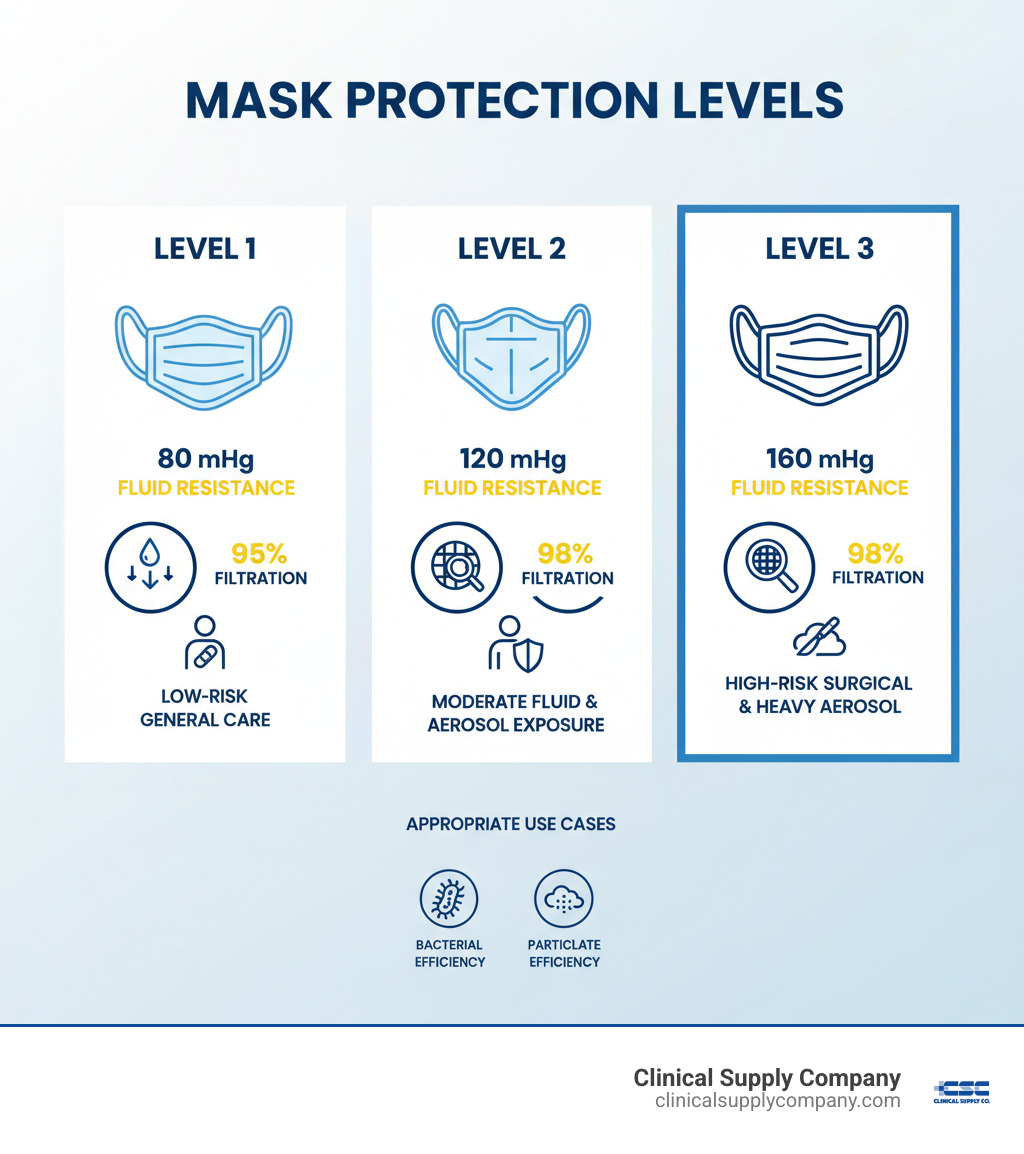
Decoding ASTM Level 3: The Gold Standard for Surgical Masks
When you see "level 3 face mask" on a box, you're looking at the highest level of protection available in surgical masks. This rating comes from ASTM International, an organization that develops technical standards for product quality and safety. For surgical masks, the relevant benchmark is ASTM F2100, a standard recognized by the U.S. Food and Drug Administration (FDA).
An ASTM Level 3 rating signifies maximum barrier protection. These masks are engineered for environments where exposure to high levels of aerosols, spray, and fluids is expected. The testing covers fluid resistance, filtration, breathability, and flammability, with Level 3 masks meeting the strictest criteria.
Key Features of an ASTM Level 3 Face Mask
A level 3 face mask earns its top-tier status by meeting these specific performance metrics:
- Bacterial Filtration Efficiency (BFE): Greater than 98%. This means the mask blocks over 98% of bacteria-sized particles (approx. 3 microns).
- Particulate Filtration Efficiency (PFE): Greater than 98%. This measures effectiveness against non-viable particles as small as 0.1 microns.
- Fluid Resistance: 160 mmHg. This is the key differentiator, indicating the mask can withstand significant splashes and sprays under high pressure, double the resistance of a Level 1 mask.
- Breathability (Delta P): Less than 5.0 mm H2O/cm². A lower number means easier breathing, ensuring comfort during long procedures.
- Flammability: Class 1. The material resists ignition and slows flame spread, an important safety feature in clinical settings.
These specifications create a maximum barrier for procedures with high fluid and aerosol exposure. For more context, see our guide on face masks in dentistry.
Who Needs This Level of Protection?
While not every situation requires a level 3 face mask, it is essential for high-risk scenarios. Key users include:
- Dental Professionals: During procedures like ultrasonic scaling, high-speed drilling, and air polishing that generate heavy aerosols mixed with saliva and blood.
- Oral Surgeons: For extractions, maxillofacial reconstruction, and when treating high-risk patients with infectious diseases.
- Surgeons and Operating Room Staff: In any surgical procedure where significant fluid splash and aerosol generation are anticipated.
- Emergency Room Personnel: For unpredictable exposure to blood, body fluids, and aerosols.
If your work involves aerosol-generating procedures or likely exposure to splatter and spray, Level 3 protection is the responsible choice. For more help selecting the right mask, see our article on considerations when buying surgical face masks.
Top-Rated Level 3 Face Masks for Uncompromised Safety
Choosing a level 3 face mask goes beyond ASTM certification. You need masks that are comfortable for long procedures, reliably available, and manufactured to high quality standards. At Clinical Supply Company, we specialize in identifying products that meet these needs for dental professionals.
 As a supplier for practices in Ohio and across the Midwest, we know that quality and certification are non-negotiable. Our focus is ensuring every level 3 face mask we offer meets or exceeds ASTM F2100 and FDA standards.
Recommended Level 3 Masks
Here are some level 3 face mask options known for combining maximum protection with practical usability:
Medicom SafeMask Architect™: These masks deliver top-tier ASTM protection with excellent breathability. They feature a shingle pleat design to prevent fluid pooling and outer-facing earloops to reduce pulling and minimize self-contamination risk. Their high-quality filtration media makes them a reliable choice for demanding procedures.
Aurelia® ASTM Level 3 Masks: Known for their robust 3-ply construction and premium melt-blown filtration material, these masks provide dependable barrier protection. They feature a secure metal nose clip and meet rigorous ASTM standards, ensuring reliability during high-risk procedures.
Clinical Supply Company's Curated Selection: We don't just stock masks; we vet them for the realities of dental practice. Our selection of level 3 face masks emphasizes bulk availability, verified certification, and the balance between maximum protection and all-day comfort. Our goal is to be your reliable partner, so you can focus on patient care, not PPE worries. For more guidance, see our guide on Choosing a Good Face Mask for Dental Staff.
_compressed.png?alt=media&token=91ec94ef-3ed6-4561-a5ba-2329e2f51b6c "Surgical Masks Level 3 (CSC)")
The right level 3 face mask should protect you completely while remaining comfortable and available when you need it. That's the standard we uphold at Clinical Supply Company.
Level 3 Masks vs. Other PPE: A Clear Comparison
Choosing the right mask means matching your protection to the risk. Understanding where a level 3 face mask fits within the broader PPE landscape helps you make smarter safety decisions.
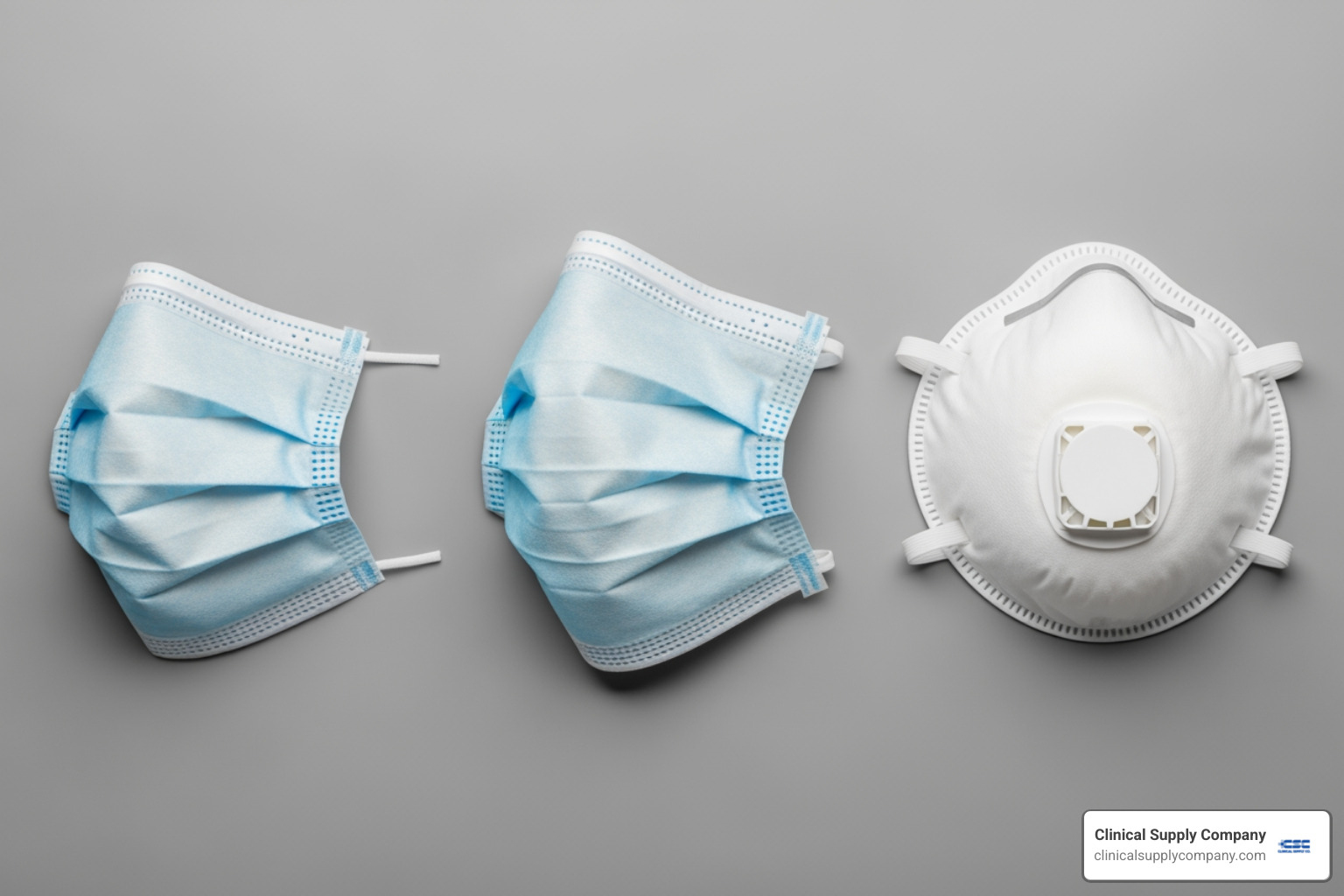
Surgical masks (Levels 1, 2, and 3) are designed to protect against splashes, sprays, and larger droplets. They act as a barrier. Respirators, like N95s, are built to filter out much smaller airborne particles and require a tight facial seal to be effective.
Comparing Protection Levels
| Feature | ASTM Level 1 | ASTM Level 2 | ASTM Level 3 | NIOSH N95/KN95 |
|---|---|---|---|---|
| Primary Use | Low-risk, general care | Moderate fluid/aerosol | High-risk, surgery | Airborne particle protection |
| Fluid Resistance | 80 mmHg | 120 mmHg | 160 mmHg | Not rated (some are) |
| BFE | ≥95% | ≥98% | ≥98% | N/A |
| PFE @ 0.1 micron | ≥95% | ≥98% | ≥98% | ≥95% |
| Fit | Loose-fitting | Loose-fitting | Loose-fitting | Tight-fitting seal |
The table shows a clear progression. Level 1 masks are for basic exams, while Level 2 masks handle light to moderate aerosols. When facing heavy aerosols, splatter, or spray, a level 3 face mask is the best defense among surgical masks. Its 160 mmHg fluid resistance rating is double that of a Level 1 mask, providing maximum barrier protection.
When to Choose a Respirator Over a Level 3 Face Mask
A level 3 face mask offers excellent fluid protection but has limitations. Because surgical masks are loose-fitting, tiny airborne particles can enter through gaps around the edges. This is where respirators come in.
N95 and KN95 respirators filter at least 95% of small airborne particles and are designed to form a tight seal around the face. This seal is critical, which is why OSHA requires fit testing for their use. You should choose a respirator over a surgical mask when:
- Treating patients with known or suspected airborne infectious diseases (e.g., tuberculosis).
- Performing aerosol-generating procedures on these patients.
In these scenarios, the superior filtration and tight seal of a properly fitted N95 are necessary. Think of it this way: a level 3 face mask is your barrier against splashes and sprays, while a respirator is your defense against microscopic airborne threats. Knowing when to use each is key to safety. For more help, see our guide on how to select the right type of face masks.
Your Buyer's Guide: Choosing and Using Level 3 Masks Correctly
Making smart choices about your level 3 face mask involves more than just picking a box. It's about verifying authenticity, storing it correctly, and ensuring a proper fit to get the protection you count on.

Verifying Your Level 3 Face Mask is Authentic
To ensure you're getting a genuine, certified level 3 face mask, follow these steps:
- Check the Packaging: Look for clear ASTM F2100 Level 3 labeling. Vague claims about filtration or layers without an official ASTM grade are a red flag.
- Choose a Reputable Supplier: Partnering with an established dental supply company like Clinical Supply Company is your best defense against counterfeits. We vet every product to ensure it meets US regulatory standards.
- Be Skeptical of Low Prices: Unusually low prices often signal counterfeit products that lack the required filtration and fluid resistance. For more guidance, see our article on considerations when buying surgical face masks.
Storage, Shelf Life, and Disposal
Proper handling is essential to maintain mask integrity:
- Storage: Keep masks in a cool, dry place, preferably in their original packaging, away from direct sunlight and contaminants.
- Shelf Life: Most masks have a shelf life of two to five years. Always check the expiration date on the box, as materials can degrade over time.
- Single-Use Only: Level 3 face masks are designed to be used once and then discarded. Reusing them increases cross-contamination risks. Learn more about why in our article, Can Face Masks Be Reused Safely?.
- Disposal: Dispose of used masks in a designated medical waste receptacle according to your practice's protocols.
Due to safety and sterility concerns, most medical mask sales are final.
Ensuring Proper Fit and Comfort
A mask's protection is only as good as its fit. For maximum effectiveness and comfort:
- Use the Adjustable Nose Piece: Mold the metal strip securely over the bridge of your nose to create a tight seal and prevent fogging of eyewear.
- Check for Gaps: The mask should fit snugly along the sides of your face. Gaps allow unfiltered air to bypass the barrier.
- Prioritize Comfort: Look for masks with soft, secure earloops that don't pull. Good breathability (measured by Delta P) is also key for extended wear.
Getting the fit right is crucial. Our guide on Face Masks: Ensure Proper Fit Every Time provides a step-by-step process. For more tips, see our article on Choosing a Good Face Mask for Dental Staff.
Frequently Asked Questions about Level 3 Face Masks
Here are answers to common questions dental professionals ask about level 3 face masks.
What are Level 3 masks made of?
Most quality level 3 face masks feature a multi-layer design:
- Outer Layer: A fluid-resistant layer, typically made of spunbond polypropylene, that acts as a shield against splashes and sprays.
- Middle Filter Layer: The core of the mask, made of melt-blown polypropylene, which uses an electrostatic charge to capture over 98% of bacteria and particles.
- Inner Layer: A soft, absorbent layer of spunbond polypropylene that rests against the skin for comfort and to manage moisture.
Reputable masks are also free of latex, graphene, and fiberglass to prevent irritation and allergic reactions.
Does the colored side of the mask go on the inside or outside?
The colored side always goes on the outside, facing away from you. This outer layer is the fluid-resistant barrier. The white, softer side is the inner layer designed for comfort against your skin.
How do prices for Level 3 masks vary?
The cost of level 3 face masks varies based on several factors:
- Brand and Quality: Established brands with proven certifications may cost more.
- Purchase Quantity: Buying in bulk (by the case) significantly reduces the per-mask cost compared to buying a single box.
- Country of Origin: Manufacturing in the USA or Canada can influence the price.
- Special Features: Anti-fog strips or unique designs can add to the cost.
- Vendor: A dedicated dental supply partner like Clinical Supply Company can often provide better pricing and bulk discounts.
While Level 3 masks are a premium product compared to Level 1 or 2, you are investing in the highest standard of surgical mask barrier protection for high-risk procedures.
Conclusion
In the demanding environments of dental and medical practices, compromising on safety is simply not an option. The level 3 face mask stands as the pinnacle of surgical mask protection, offering an essential barrier against fluids, aerosols, and microbial contamination. From its rigorous ASTM F2100 certification to its superior filtration and fluid resistance, we've explored why this mask is the gold standard for high-risk procedures.
We've digd into the specific features that make Level 3 masks so effective, highlighted their critical role for professionals like us in dentistry, and even compared them to other PPE to clarify when a respirator might be necessary. We've also equipped you with a buyer's guide, covering everything from verifying authenticity and proper storage to ensuring a comfortable and secure fit.
Choosing the right level 3 face mask is an investment in the health and safety of your team and your patients. By understanding the science behind these masks and making informed purchasing decisions from reputable suppliers, you empower your practice with uncompromised protection.
We are dedicated to helping you steer these choices. For a comprehensive understanding of all your mask needs, we invite you to Explore our complete guide to face masks in dentistry.


