

Why Understanding Surgical Mask Types Matters for Clinical Safety
Surgical face masks are a first line of defense against infection in dental and medical settings, but not all masks provide the same protection. Understanding the differences is crucial for clinical safety.
Masks are rated by ASTM as Level 1 (low risk), Level 2 (moderate risk), or Level 3 (high risk), dictating their use in procedures ranging from routine exams to oral surgery. Key performance metrics include bacterial filtration efficiency (BFE), which ranges from ≥95% to ≥98%, and fluid resistance, which is significantly higher in Level 3 masks. Despite these differences, a Level 1 and Level 3 mask can look identical.
This visual similarity masks a dramatic difference in performance. Research shows that due to edge leakage from a loose fit, many users fail proper fit tests. This makes understanding material construction and filtration standards critical for actual protection, not just compliance.
Regulated by the FDA (21 CFR 878.4040), surgical masks create a physical barrier against droplets and splashes and provide source control by reducing the wearer's respiratory secretions from reaching others. However, their loose fit is less effective against small airborne particles compared to N95 respirators. For dental professionals, choosing the right mask for each procedure is the difference between adequate protection and preventable exposure.
I'm Adam Schuh, President and CEO of Clinical Supply Company. We work to ensure every surgical face mask we source meets rigorous FDA and ASTM standards. This guide will help you decode the ratings and choose the right mask for your practice.
The Anatomy of a Surgical Mask: Materials and Performance
A surgical face mask is a precision-engineered device, built layer by layer to create a protective barrier that's both breathable and effective. Understanding its construction explains why performance varies between masks.
The Multi-Layer Construction
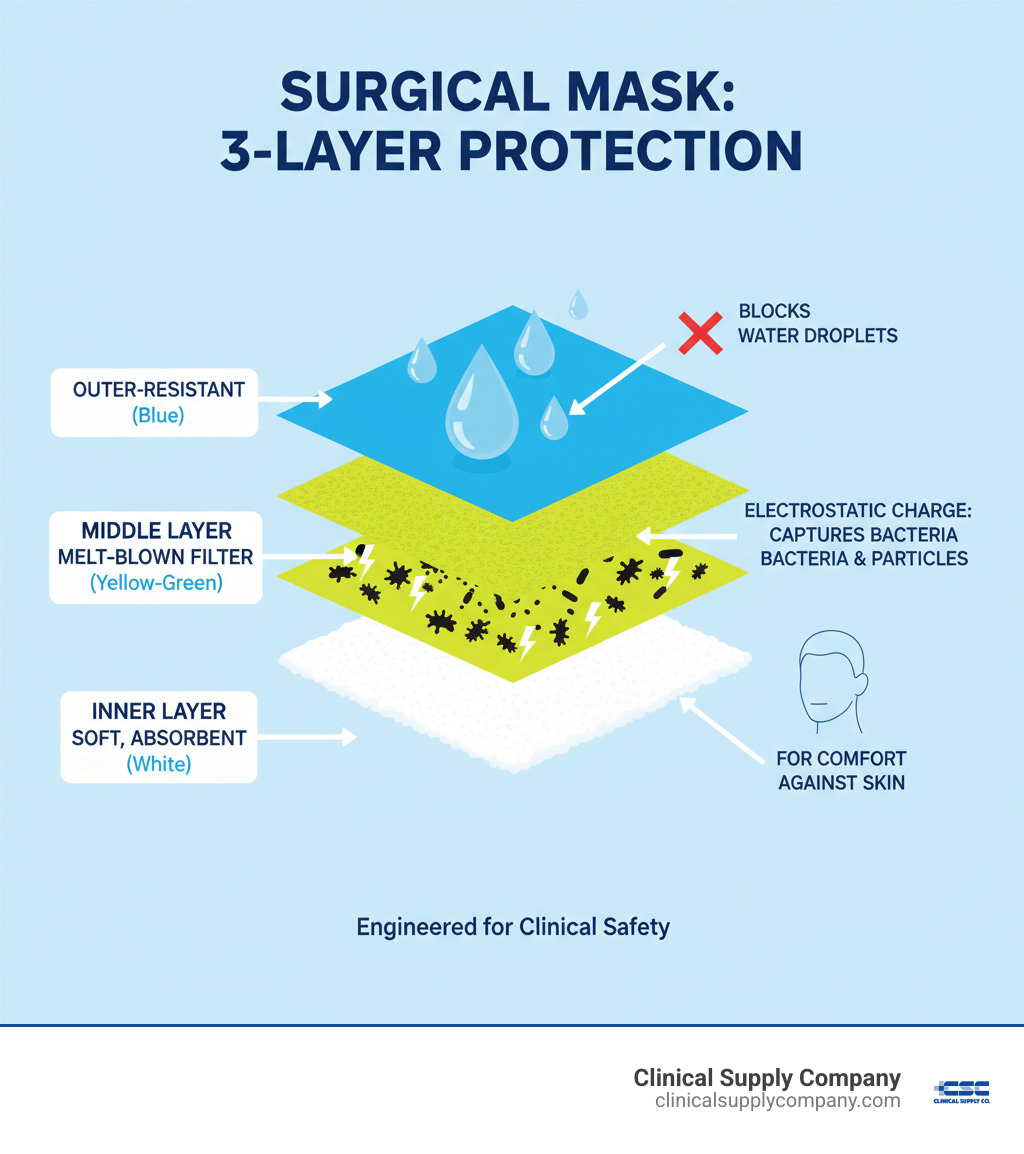
A standard surgical face mask has three distinct layers working together.
The inner layer, touching your face, is a soft, absorbent non-woven fabric. It manages moisture from your breath, keeping you comfortable during long procedures and preventing dampness from building up.
The middle filter layer is the core of the mask's protective power. It's made from melt-blown polypropylene, a web of microfibers that traps particles. Many filters also carry an electrostatic charge, which acts like a magnet to attract and capture tiny particles like bacteria and viruses, significantly boosting filtration efficiency.
The outer layer is a fluid-resistant barrier, usually colored, that repels splashes, sprays, and large droplets. In dental settings, where aerosols and splatter are common, this layer is essential for keeping contaminants from soaking through to the filter.
Together, these non-woven layers create a breathable yet protective barrier, allowing air to flow while blocking harmful particles.
Common Types and Their Applications
While the three-layer structure is consistent, surgical face masks come in different styles to suit various needs.
Earloop masks are the most common type, known for being quick to put on and take off. They are the go-to choice for general patient care, routine cleanings, and everyday clinical work.
Tie-on masks feature four ties that secure behind the head and neck. They offer a more adjustable and secure fit, often preferred in operating rooms and for surgical suites to maintain a sterile field.
Anti-fog features are a game-changer for professionals who wear glasses or loupes. Masks may include a foam strip or adhesive along the nose bridge to create a better seal and direct exhaled breath away from eyewear, ensuring clear vision during procedures.
Integrated visors offer an all-in-one solution, combining a mask with an attached clear plastic shield for extra eye and face protection against splashes. They provide convenient added coverage for moderate-exposure situations.
The key is matching the mask type and its ASTM rating to the specific procedure. While style affects comfort, the rating determines its protective capability.
Decoding the Ratings: How to Choose High-Quality Surgical Face Masks
Choosing the right surgical face mask is about understanding the science that protects you and your patients, as not all masks are created equal, even if they look identical.
Understanding ASTM F2100 Standards
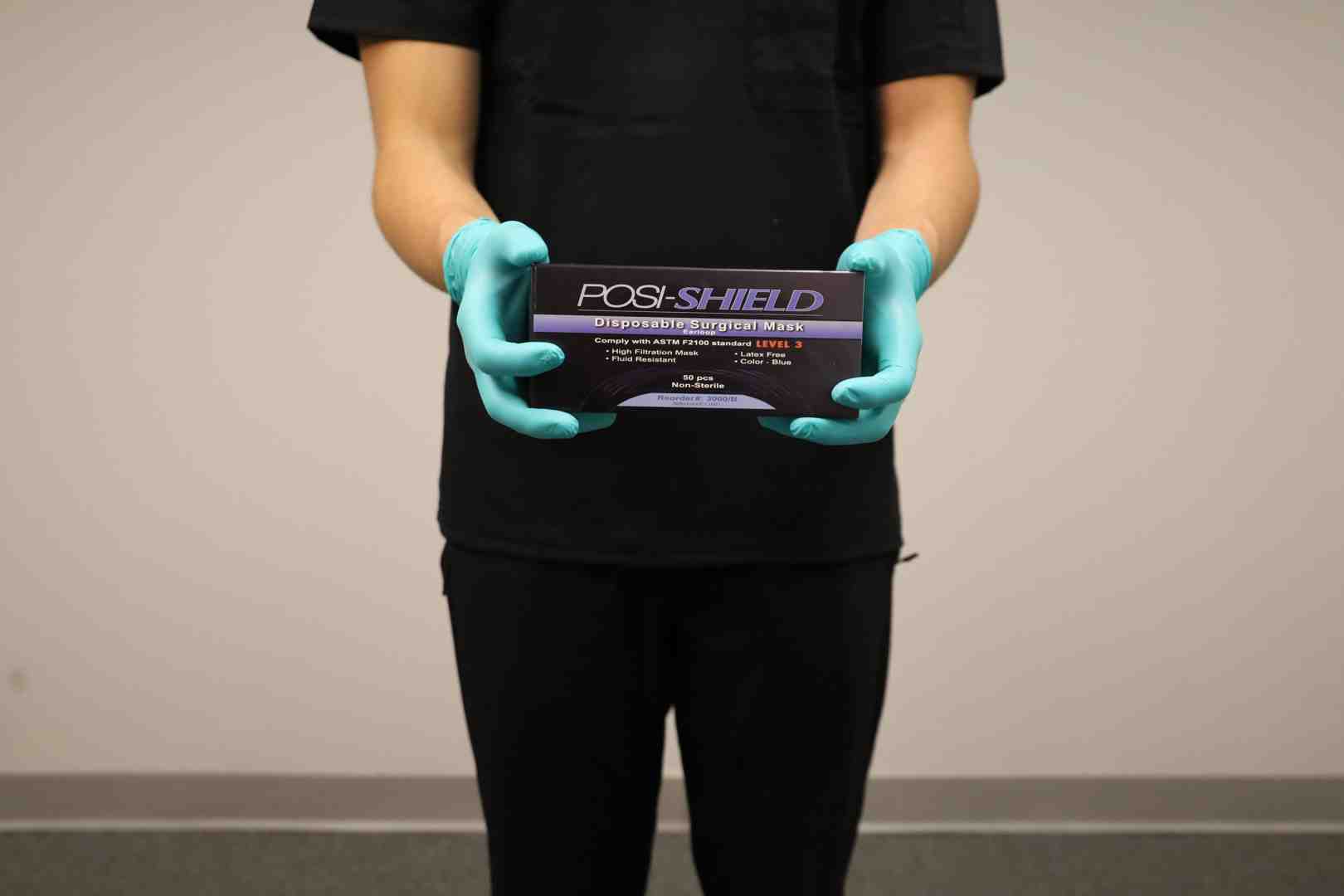
ASTM International sets the performance standards for medical face masks in the U.S., recognized by the FDA as ASTM F2100. This standard classifies masks into three performance levels that correspond to the risk exposure of different dental procedures.
At Clinical Supply Company, we are committed to sourcing only masks that meet or exceed these critical ASTM standards, because your safety is non-negotiable.
Here's how ASTM Level 1, 2, and 3 masks compare:
| Metric | ASTM Level 1 (Low Barrier) | ASTM Level 2 (Moderate Barrier) | ASTM Level 3 (High Barrier) |
|---|---|---|---|
| Bacterial Filtration Efficiency (BFE) | ≥95% | ≥98% | ≥98% |
| Particulate Filtration Efficiency (PFE) | ≥95% (at 0.1 micron) | ≥98% (at 0.1 micron) | ≥98% (at 0.1 micron) |
| Fluid Resistance (mmHg) | 80 mmHg | 120 mmHg | 160 mmHg |
| Differential Pressure (Delta P) (Breathability) | <4.0 mm H₂O/cm² | <5.0 mm H₂O/cm² | <6.0 mm H₂O/cm² |
| Flame Spread | Class 1 | Class 1 | Class 1 |
Source: ASTM F2100-21, DemeTECH product information
These metrics are based on rigorous testing to predict real-world performance. For complete details, review the Standard Specification for Performance of Materials Used in Medical Face Masks.
Key Performance Metrics for surgical face masks
Understanding these metrics is key to ensuring your safety.
Bacterial Filtration Efficiency (BFE) measures how well a mask blocks bacteria-containing droplets. Level 1 masks filter at least 95%, while Level 2 and 3 masks filter 98% or more.
Particulate Filtration Efficiency (PFE) measures filtration of sub-micron particles (down to 0.1 microns), including some viruses. Level 3 masks offer superior protection with a ≥98% PFE rating.
Fluid Resistance indicates how much pressurized fluid (measured in mmHg) a mask can withstand before penetration. A Level 1 mask resists 80 mmHg, while a Level 3 mask resists 160 mmHg, making it essential for procedures with high splash or spray risk.
Differential Pressure (Delta P) measures breathability. A lower number means easier breathing. Modern high-filtration masks are engineered to balance excellent protection with comfort for extended wear.
Flame Spread is a safety rating ensuring the mask resists ignition from heat sources like electrosurgical units. All ASTM-rated masks must be Class 1.
Understanding these metrics empowers you to match a mask's performance to procedural risks, a science-based approach we champion at Clinical Supply Company.
Surgical Masks vs. Other Face Coverings
In any healthcare setting, you'll see various face coverings, but they are not interchangeable. Understanding how surgical face masks compare to other options like N95 respirators and cloth masks is key to making informed protection choices.
Surgical Masks vs. N95/KN95 Respirators
The primary difference between a surgical mask and an N95 respirator is the fit. Surgical face masks are loose-fitting by design. They create a physical barrier but allow air to leak around the edges. N95 respirators are engineered for a tight facial seal, forcing inhaled and exhaled air through the filter.
This fit dictates their function. Surgical masks excel at source control—blocking large droplets and sprays from leaving the wearer's mouth and nose. They also protect the wearer from external splashes. N95s, regulated by NIOSH, are designed for respiratory protection, filtering at least 95% of tiny airborne particles to protect the wearer from inhalation. The CDC infographic on mask vs. respirator differences clearly illustrates this.
For aerosol-generating dental procedures, an N95 respirator is often the best choice for protecting the wearer from inhaling fine particles. While a Level 3 surgical face mask offers excellent fluid resistance and filtration, its loose fit cannot provide the same level of inward protection against small aerosols as a properly fitted N95.
Why Medical-Grade surgical face masks Outperform Cloth Masks
Cloth masks are not suitable for clinical settings. Medical-grade surgical face masks are superior for several critical reasons.
First, cloth masks have inconsistent and unverified filtration efficiency, which depends on the fabric, weave, and number of layers. In contrast, medical-grade masks are held to the rigorous ASTM F2100 standard, ensuring consistent, predictable performance. Second, cloth masks lack a fluid-resistant layer, offering little to no protection against splashes and sprays common in dentistry. If a cloth mask gets wet, its filtration capability drops dramatically.
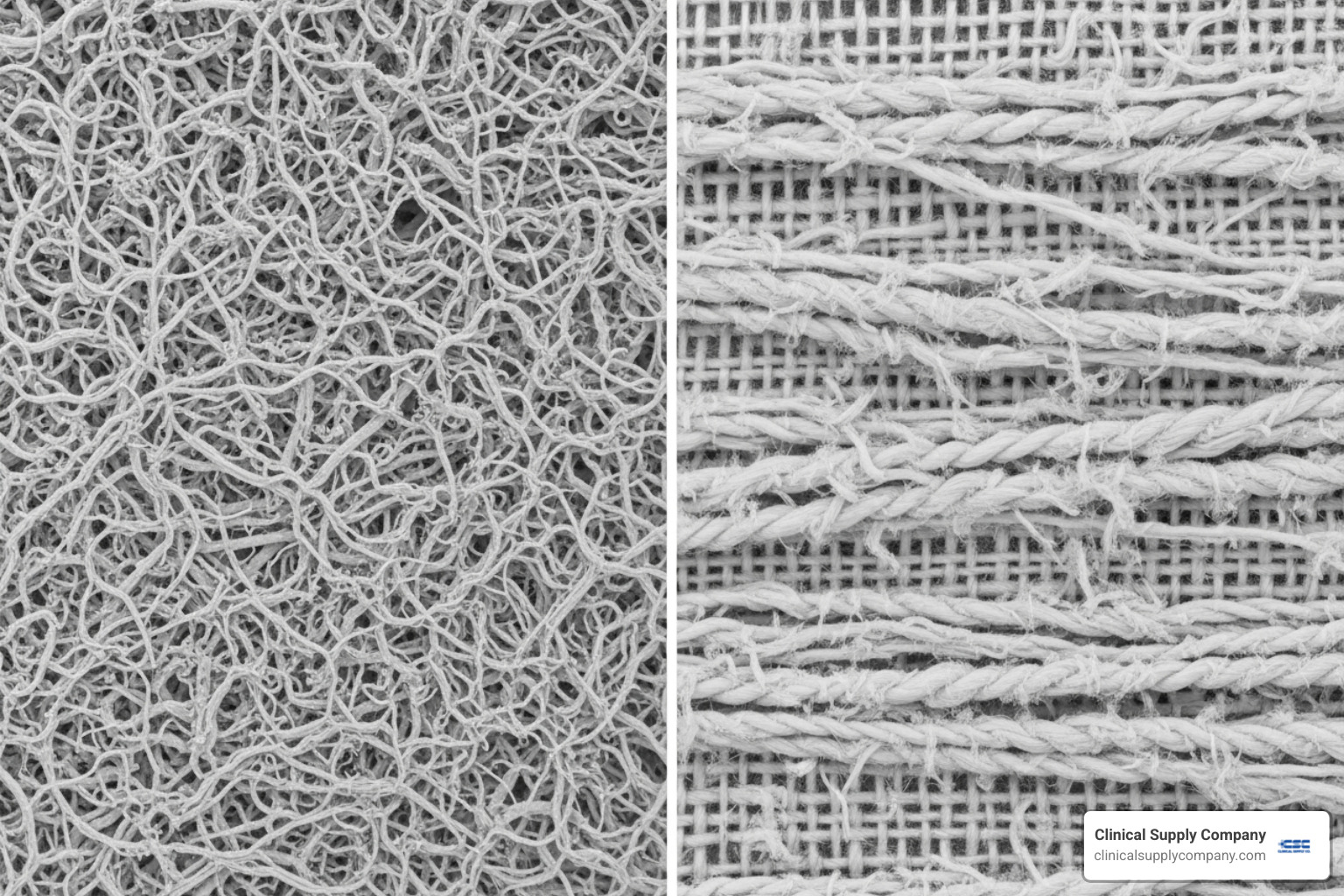
Finally, surgical face masks are designed for single use, which is crucial for hygiene and preventing cross-contamination. Cloth masks require laundering, which can degrade their filtration properties over time. The microscopic structure shows the difference: the engineered, electrostatically charged fibers of a surgical mask create a dense web to trap particles, whereas a cloth mask's simple weave has large gaps.
For dental professionals, there is no substitute for the verified protection of a medical-grade surgical face mask.
Best Practices: From Proper Wear to Purchase
Even the highest-rated surgical face masks are only effective if used correctly. Proper technique is just as important as the product's specifications.
A Step-by-Step Guide to Proper Use and Disposal
Getting these details right is essential for safety. Follow these steps for every mask.
- Perform Hand Hygiene: Before touching the mask, wash your hands with soap and water or use an alcohol-based hand sanitizer.
- Inspect the Mask: Check for any tears or damage. If it's compromised, discard it and get a new one.
- Secure the Mask: Hold the mask by the ear loops or ties. Ensure it completely covers your nose, mouth, and chin.
- Form a Seal: Use both index fingers to mold the flexible nose piece to the bridge of your nose. This minimizes air leakage and prevents fogging of eyewear. Pull the bottom of the mask down under your chin.
- Avoid Touching: Once on, do not touch the front of the mask, as it is considered contaminated. If you must adjust it, use the loops or ties and clean your hands immediately after.
- Safe Removal and Disposal: To remove, handle only the ear loops or ties. Pull the mask away from your face and immediately discard it in a closed waste bin. These masks are single-use only. Never wash or reuse a disposable surgical face mask, as this destroys the filter's electrostatic charge and filtration capability. Finish by performing hand hygiene.
Sourcing, Pricing, and Avoiding Counterfeits
Navigating the market for reliable surgical face masks can be tricky. Here’s how to ensure you get quality products.
- Work with a Reputable Dental Supplier: A specialized supplier like Clinical Supply Company vets manufacturers to ensure products meet medical standards. Unlike massive online marketplaces with unverified sellers, we focus on the quality control that clinical use demands.
- Verify FDA Registration: Medical-grade PPE must be registered with the FDA. If a supplier cannot provide this information, it's a major red flag.
- Consider "Made in USA": Domestic manufacturing, such as with brands like DEMETECH, often indicates higher quality control and more reliable supply chains. BYD CARE is another brand known for consistent ASTM Level 3 performance.
- Understand Pricing: Quality ASTM Level 3 masks typically cost between $0.30 to $0.60 per mask ($15-$30 per box of 50). Prices that seem too good to be true often indicate compromised quality or counterfeit products.
- Buy in Bulk: Bulk purchasing reduces the per-unit cost and ensures a consistent supply, preventing disruptions in your practice.
At Clinical Supply Company, we make sourcing reliable PPE straightforward, so you can focus on patient care.
Frequently Asked Questions about Surgical Masks
We hear these questions often from dental professionals. Here are straight answers to the most common concerns about surgical face masks.
Can I reuse a disposable surgical mask?
The answer is a firm no. Disposable surgical face masks are designed for single use only. Moisture from your breath degrades the filter's effectiveness, and washing or disinfecting it with alcohol will permanently destroy the filter's critical electrostatic charge, ruining its filtration capability.
Furthermore, the outer surface of a used mask is contaminated. Reusing it creates a significant risk of transferring pathogens to your hands, surfaces, or yourself. For safety and efficacy, a fresh mask should be used for each patient or procedure. At Clinical Supply Company, we work to keep prices competitive so practices never have to cut corners on safety.
Which side of the surgical mask faces out?
This is a simple but crucial detail. The colored side (blue, green, etc.) always faces out. This is the fluid-resistant layer designed to repel splashes and sprays.
The white side faces in, against your skin. This soft, absorbent layer wicks away moisture from your breath for comfort. Wearing the mask inside-out compromises its function, as the absorbent layer would face outward and soak up contaminants. A quick check—color out, white in—ensures your surgical face mask performs as intended.
Do surgical masks protect the wearer from viruses?
This question requires a nuanced answer. Surgical face masks are highly effective for their intended purpose, but it's important to understand their strengths and limitations.
Their primary strength is source control: they are excellent at capturing the wearer's respiratory droplets, protecting patients and colleagues. They also provide the wearer with good protection against large droplets and splashes from patients. However, because surgical face masks are loose-fitting, they do not form a tight seal like an N95 respirator. This means very small airborne particles, including some viruses, can be inhaled around the edges.
While the filter material itself is highly efficient (≥98% for Level 3), the leakage around the sides is the limiting factor for inward protection from aerosols. For routine dental work, a surgical face mask provides excellent protection. For procedures that generate significant aerosols, many guidelines recommend an N95 respirator for its tight seal and superior inward protection.
Conclusion
We've explored the essential details of surgical face masks, from their multi-layer construction to the performance ratings that guide their use.
We've seen how the three-layer design—absorbent inner, filtering middle, and resistant outer—works to protect both wearer and patient. We decoded the ASTM F2100 ratings, clarifying why a Level 3 mask is the standard for high-risk procedures involving aerosols and splatter. We also distinguished surgical face masks from N95 respirators, which offer a tighter seal for respiratory protection, and from cloth masks, which lack the standardized performance required for clinical settings.
However, the best mask is only effective when used correctly. Proper wear, single-use disposal, and sourcing from a trusted supplier are non-negotiable for ensuring safety. A mask worn incorrectly or purchased from a questionable source offers a false sense of security.
At Clinical Supply Company, we've made it our mission to be more than just a supplier for dental professionals in Ohio and across the nation. We are your partners in infection control. We vet every surgical face mask we sell to ensure it meets the rigorous FDA and ASTM standards your practice relies on.
Choosing the right mask is about protecting your team, safeguarding your patients, and upholding the trust at the heart of your practice. That's our commitment at Clinical Supply Company—to be your reliable source for the supplies that keep your practice running safely.
Ready to ensure your practice has the protection it needs? Explore our full range of infection control supplies and find why dental professionals trust us for quality and service.