

Why Indigo Nitrile Exam Gloves Are the Smart Choice for Dental Professionals
Indigo nitrile exam gloves combine superior protection with exceptional comfort, making them ideal for dental practices that demand both safety and dexterity. Here's what you need to know when selecting the right pair:
Key Selection Criteria:
- Material: Nitrile (latex-free, reduces allergy risk)
- Thickness: 3-6 mil (thicker = more protection, thinner = better tactile sensitivity)
- Certifications: FDA 510(k) clearance, ASTM D6319, AQL 1.5 or lower
- Features: Powder-free, textured grip, beaded cuff
- Sizes: Small, Medium, Large, X-Large (ambidextrous fit)
- Packaging: 100-200 gloves per box, 1000-2000 per case
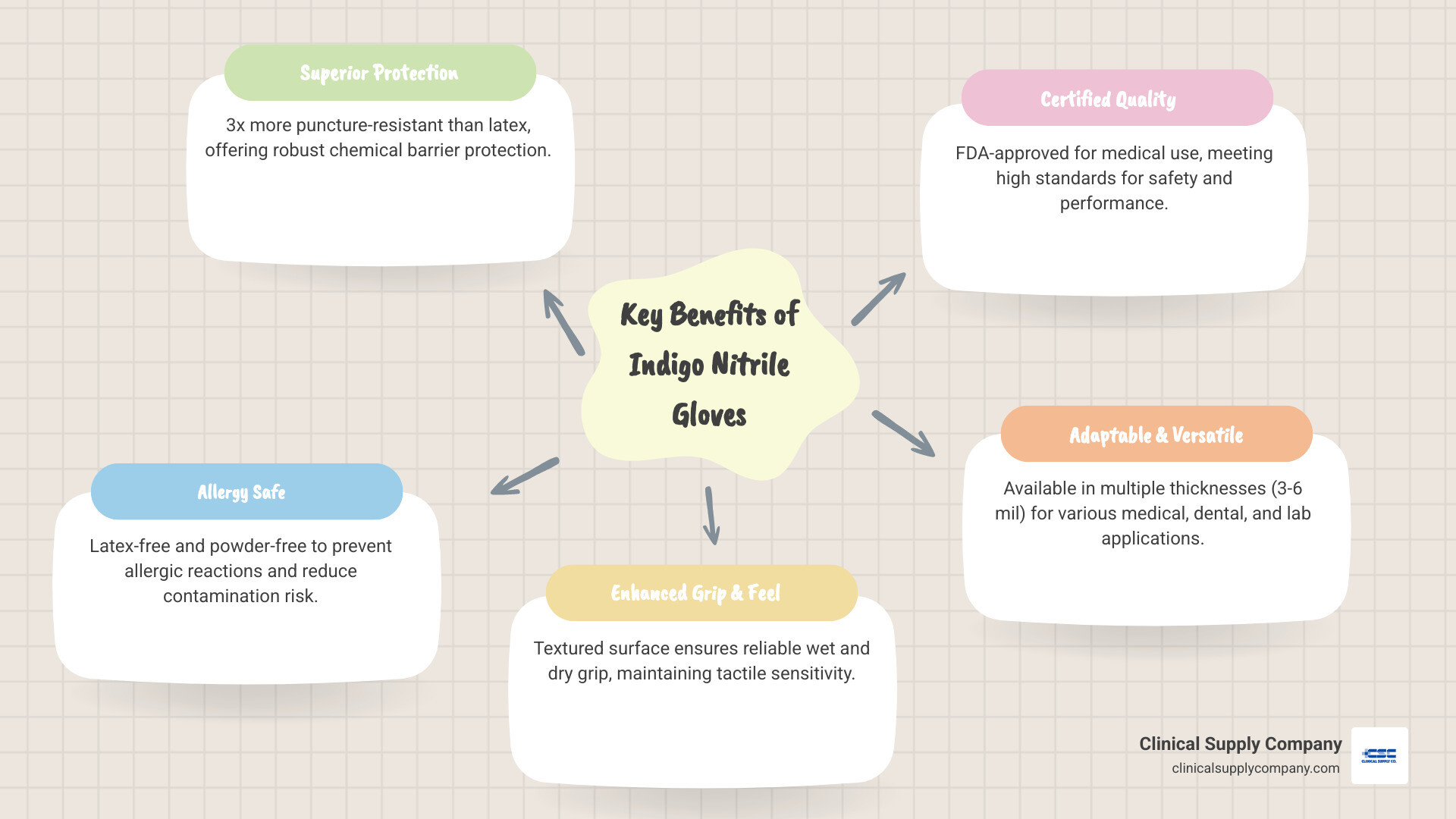
Choosing the right gloves protects your team and patients while maintaining the precision your work demands. Nitrile gloves are 3x more puncture-resistant than latex, offer excellent chemical protection, and won't trigger latex allergies that affect millions of healthcare workers and patients.
The research is clear: healthcare professionals favor indigo nitrile exam gloves for their "exceptional comfort and high tactile sensitivity," according to product testing data from leading suppliers. The indigo color provides visual contrast that reduces eye strain during long procedures and makes contamination easier to spot.
I'm Adam Schuh, President and CEO of Clinical Supply Company, where I've spent years working with dental professionals to source indigo nitrile exam gloves that meet the highest FDA and ASTM standards. My team and I steer global supply chain challenges to ensure practices like yours have access to reliable, quality-tested protection at stable prices.
What Makes Indigo Nitrile Exam Gloves a Superior Choice?
During a procedure, you need to trust your gloves will hold up. At Clinical Supply Company, we've seen how the right gloves can make or break a dental professional's day. That's why indigo nitrile exam gloves have become such a trusted choice in practices across the country.
Let's start with the material itself. Nitrile is a synthetic rubber that offers serious strength without the allergy concerns of natural latex. We're talking about puncture resistance that's up to three times better than standard latex gloves. This means fewer mid-procedure glove changes, more confidence with sharp instruments, and a smoother workflow.
The chemical resistance of nitrile is equally impressive. These gloves create a reliable barrier against the substances you encounter daily—blood-borne pathogens, petrochemicals, oils, and solvents. This protection gives you one less thing to worry about.
Here's where indigo nitrile exam gloves really shine: they're completely latex-free. With latex allergies affecting millions, this isn't a small detail—it's a game-changer. Your staff can work without worry, and patients with sensitivities can feel safe in your chair.
These gloves are also powder-free, which matters more than you might think. No powder means no residue on materials, no wound contamination, and no airborne irritants, creating a cleaner, safer environment.
But protection means nothing if the gloves are uncomfortable or clumsy. That's where the design really impresses. Indigo nitrile exam gloves conform to your hand's natural shape, especially as they warm to body temperature. The result? A custom fit that feels secure without being restrictive. Users consistently praise the "exceptional comfort and high tactile sensitivity" these gloves deliver.
That thin-yet-durable construction is the sweet spot—enough protection to keep you safe, but not so much bulk that you lose your sense of touch. When you're doing precision work, that tactile feedback is everything. For more details on how nitrile stacks up against other materials, check out our guide on Nitrile Gloves: Benefits and Drawbacks to Know.
The Unique Advantage of the Indigo Color

You might wonder if the color of a glove really matters. Turns out, it does—and in more ways than you'd expect.
The indigo color creates fantastic visual contrast against lighter surfaces. Spotting a tiny tear or contaminant on a white glove against a patient's skin or your white coat is tough. With indigo, that contrast is immediate and obvious. Your eyes don't have to work as hard, which means less strain during long procedure days.
Many practices use color-coding systems to organize their workflows. Indigo nitrile exam gloves fit perfectly into these systems, giving you instant visual identification. It's a simple way to keep everyone on the same page and maintain safety standards.
Aesthetically, the indigo color looks professional and modern, conveying cleanliness. Some customers even say the color adds a "fun pop" to their routine—a small thing that makes a difference when wearing gloves for hours.
The bottom line? The indigo color isn't just pretty. It reduces eye strain, supports safety protocols, and creates a professional atmosphere in your practice.
Key Features for Best Performance
The difference between good gloves and great gloves often comes down to the details. With indigo nitrile exam gloves, those details are built right in.
The textured grip is probably the most important feature. That micro-roughened surface on the fingertips and palm is engineered for control. When you're handling small instruments or working with slippery materials, that grip keeps everything secure. It works in both wet and dry conditions, so you're never second-guessing your hold.
Tactile sensitivity is the other side of that coin. Protection is crucial, but not if it turns your hands into clumsy mitts. Quality indigo nitrile exam gloves strike that perfect balance—thick enough to protect, thin enough to feel. You maintain the delicate touch you need for precision work, even through the barrier.
The beaded cuff might seem like a minor detail, but it pulls its weight. That rolled edge at the wrist makes gloves easier to put on, prevents tearing during donning, and stops liquids from rolling back onto your arm. It's one of those features you don't appreciate until you've used gloves without it.
All these elements work together to create a secure fit. When a glove conforms naturally to your hand, it becomes almost invisible—in the best way. You can move naturally, work precisely, and get through long shifts without hand fatigue. That's the kind of performance that makes a real difference in your day-to-day work.
Want to dive deeper into why nitrile consistently outperforms other materials? Our article Why Nitrile Outperforms Latex: Allergies, Durability, Compliance breaks down the specifics.
Indigo Nitrile Exam Gloves: How They Stand Out
The world of disposable gloves has evolved. You may remember when latex was king before we learned about its allergy risks. Vinyl was an affordable, latex-free alternative, but it often lacked the durability for real-world demands.
This is where indigo nitrile exam gloves changed the game entirely.
Nitrile material brings together the best qualities of both predecessors while eliminating their weaknesses. You get the tactile sensitivity of latex with the allergy-free peace of mind of vinyl—but with durability that actually delivers. When you're working with sharp instruments or handling chemicals, nitrile consistently outperforms both latex and vinyl.
The protection levels offered by indigo nitrile exam gloves are genuinely impressive. They create a robust barrier against the full spectrum of threats you face daily: blood-borne pathogens, disinfectants, cleaning solutions, and dental materials. This comprehensive defense gives you confidence that your hands are protected, procedure after procedure.
Cost-effectiveness is where many practices initially hesitate. While the per-box price might be slightly higher than vinyl, indigo nitrile exam gloves actually save you money. Their superior durability means fewer mid-procedure changes, less waste, and more consistent protection. Over time, this durability translates to your bottom line, especially with bulk purchasing.
For a detailed comparison of how nitrile stacks up against other glove materials in real-world applications, our team has put together a comprehensive guide: Nitrile Gloves vs Other Gloves: Key Differences.

Indigo Nitrile Exam Gloves: Key Benefits
Let's talk about what really matters when you're choosing gloves for your practice. These are the features that impact your daily work, your team's safety, and your patients' well-being.
Allergy risk is the elephant in the room that nitrile completely eliminates. Being 100% latex-free means no one in your office needs to worry about Type I latex allergies—not your hygienists, assistants, or patients. This creates a safe environment where everyone can focus on care rather than managing allergic reactions.
Durability is where indigo nitrile exam gloves truly shine. Nitrile is inherently tougher than both latex and vinyl—up to 3x more puncture-resistant than standard latex gloves. It's a measurable difference you'll notice. Fewer tears mean fewer interruptions and more consistent protection.
The puncture protection deserves special attention. When you're working with explorers, scalers, and needles, the last thing you need is a glove failure. The superior puncture resistance of nitrile reduces your risk of needle sticks and cuts that could expose you to blood-borne pathogens. This feature has made nitrile the preferred choice in high-risk healthcare environments.
Chemical barrier protection extends your safety beyond the operatory. These gloves resist a wide range of chemicals—disinfectants, cleaning solutions, and various dental materials. Your hands stay protected whether you're chairside or handling sterilization duties.
Comfort might seem secondary to protection, but it's not. Advanced nitrile formulations deliver remarkable tactile sensitivity. Many indigo nitrile exam gloves conform to your hand's natural shape as they warm to body temperature, creating a custom-like fit. This reduces hand fatigue during long days of back-to-back appointments.
Fit and flexibility work hand-in-hand with comfort. Nitrile's elasticity provides a snug fit that moves with your hands. This flexibility is essential for the fine motor skills dentistry demands—you need gloves that improve your dexterity, not hinder it.
Protection level meets the rigorous "exam grade" standards set by the FDA. This designation means your gloves have been tested and proven to provide a reliable barrier against biological and chemical hazards. It's the foundation of infection control in your practice.
Cost considerations become clearer when you look at the full picture. Yes, the initial investment per box might be slightly higher than vinyl. But when gloves last longer and perform better, you're actually spending less over time. We also offer quantity discounts—10+ boxes at a reduced price per box—making it even easier to stock up and save.
| Feature | Indigo Nitrile Exam Gloves Strengths |
|---|---|
| Durability | High resistance to rips, tears, and punctures (up to 3x latex) |
| Allergy Risk | 100% Latex-free, eliminating Type I latex allergies |
| Protection | Excellent chemical barrier; strong defense against pathogens |
| Cost | Cost-effective due to durability; bulk discounts available |
Decoding the Specs: How to Select the Right Indigo Nitrile Exam Gloves
Choosing the right indigo nitrile exam gloves for your practice isn't as simple as grabbing a box off the shelf. The right pair can make your workday smoother, protect your team, and save you money. At Clinical Supply Company, we've helped countless dental professionals steer these decisions, and we're here to walk you through what really matters. Think of this as your friendly guide to Choosing the Right High-Quality Glove for You.
Understanding Thickness (Mil) and Texture
Let's talk about thickness first, as it makes a huge difference in how your gloves perform. Thickness is measured in "mil"—one thousandth of an inch. It might sound technical, but thicker gloves offer more protection, while thinner gloves provide better tactile sensitivity.

If you're doing precision work like routine exams, you'll probably love 3 to 4 mil gloves. These thinner options give you incredible tactile sensitivity, almost like you're not wearing gloves at all. You can feel what you're doing, which is essential for fine motor control. Even at this thickness, quality nitrile delivers solid puncture and chemical resistance.
Moving up to 5 to 5.9 mil, you hit a sweet spot many dental professionals prefer. These gloves balance protection with feel beautifully. They're tough enough for more demanding procedures and extended wear without sacrificing dexterity. This is often the goldilocks zone for general dental work.
For situations requiring maximum protection—like handling harsh chemicals—6 mil and thicker gloves are your armor. They're incredibly durable, though you might notice a slight trade-off in tactile feedback. Most dental practices won't need this level daily, but the option exists.
Now, let's talk about texture. Most quality nitrile gloves feature textured fingertips or a fully micro-roughened surface. This is a game-changer when working in wet or slippery conditions. Whether you're dealing with saliva, blood, or irrigation fluids, that textured grip keeps instruments securely in your hands. You maintain control, which means better outcomes and safer work.
Navigating Certifications and Quality Standards
Now for the important but sometimes dry topic of certifications. Understanding these standards is crucial to protecting yourself and your patients. When you see certain certifications on indigo nitrile exam gloves, you're getting real assurance that these gloves do what they're supposed to do.
The big one is FDA 510(k) clearance (see 510(k) premarket notification)). In the United States, any medical glove needs this stamp of approval from the Food and Drug Administration. It means the gloves have been reviewed and found safe and effective for medical use. When you see "exam grade" on a box, this FDA clearance is part of what that means—these gloves are approved for protecting against pathogens during medical procedures.
Then we have ASTM standards, set by the American Society for Testing and Materials (learn more about ASTM International). The key one for nitrile exam gloves is ASTM D6319, which lays out minimum requirements for physical properties like tensile strength, stretch, and freedom from holes. Some indigo nitrile exam gloves also meet ASTM D6978-05, the "chemo-tested" standard. This matters if your practice handles chemotherapy drugs, as it shows the gloves resist permeation by certain hazardous medications.
You'll also see AQL, or Acceptable Quality Limit (background on acceptance sampling). This is a quality control measure that indicates how many defects might be in a batch. For medical gloves, an AQL of 1.5 is the common standard, meaning a very low probability of pinholes. Many premium indigo nitrile exam gloves meet or beat this standard, with some achieving AQL 1.0 for even better integrity.
One bonus feature: some nitrile gloves also comply with FDA food contact regulations (like FDA 21 CFR 177.2600), which can be useful if your practice has a lab that requires food-grade safety.
While you might see European EN standards listed on some products, our focus at Clinical Supply Company is ensuring your gloves meet U.S. FDA and ASTM standards. That said, international certifications can be an extra indicator of robust testing.
Finding the Perfect Size and Packaging
Once you've sorted out the technical specs, it's time to get practical about fit and how you buy your gloves. This part is straightforward, but getting it right makes a real difference.
All indigo nitrile exam gloves are ambidextrous, meaning any glove fits either hand. This simplifies your life—no sorting, no confusion, just grab and go. It also means you can stock fewer SKUs while serving your whole team.
Sizing is where comfort meets performance. We offer the full range: Small, Medium, Large, and X-Large. A proper fit isn't just about comfort. Gloves that are too tight restrict movement and tear more easily. Gloves that are too loose compromise dexterity and can increase contamination risk. We recommend keeping multiple sizes on hand so everyone on your team can find their perfect fit.
When it comes to packaging, you have options designed around your practice's operations. Most commonly, indigo nitrile exam gloves come in boxes of 100 gloves. Some brands offer boxes of 200, which can be convenient if you go through gloves quickly.
For bulk purchasing, gloves typically come in cases. You'll find cases of 1000 gloves (10 boxes of 100) or cases of 2000 gloves (10 boxes of 200). Buying in bulk isn't just about having plenty on hand—it's about saving money through quantity discounts and cutting down on reordering. Many suppliers, including us at Clinical Supply Company, offer better pricing when you order 10 or more boxes.
We work hard to make sure dental practices across Ohio and nationwide get competitive pricing and reliable delivery. Managing your supply chain shouldn't be a headache—it should be one less thing to worry about so you can focus on what you do best: taking care of your patients.
Frequently Asked Questions about Indigo Nitrile Exam Gloves
Over the years, I've had countless conversations with dental professionals who want to make the best choices for their teams and patients. The questions about indigo nitrile exam gloves tend to follow similar patterns—and they're all great questions that deserve thorough answers. Let me address the ones we hear most often.
Are indigo nitrile exam gloves safe for people with latex allergies?
This is usually the first question we get, and I'm always happy to give a definitive answer: yes, absolutely. Nitrile is a synthetic rubber that doesn't contain any of the natural rubber latex proteins responsible for Type I latex allergies. This is a game-changer for many practices.
Think about it—latex allergies affect millions of healthcare workers and patients. Some reactions are mild, like skin irritation or hives, but others can be severe and even life-threatening. By choosing indigo nitrile exam gloves, you're creating a safer environment for everyone who walks through your door, whether they're on your team or sitting in your chair. It's one of those decisions that protects both your staff and the people you serve.
If you're dealing with team members or patients who have specific allergy concerns, our article on Allergy Concerns with Latex-Free Exam Gloves goes into more detail about managing these situations in your practice.
What does 'exam grade' signify?
When you see "exam grade" on a box of gloves, that's not just marketing language—it's a meaningful designation that tells you these gloves have passed rigorous testing. Specifically, it means the gloves meet the performance standards and testing requirements set by the U.S. Food and Drug Administration (FDA) for use in medical examinations and procedures.
These standards ensure the gloves provide a reliable barrier against pathogens and contaminants, which is exactly what you need when you're working in someone's mouth or handling potentially infectious materials. The FDA's oversight means you can trust that exam-grade gloves will perform consistently, helping you maintain proper infection control protocols in your practice.
In practical terms, when you reach for a pair of exam-grade indigo nitrile exam gloves, you know they're approved for the clinical work you do every day. It's that simple.
What is the typical shelf life and how should I store them?
Most indigo nitrile exam gloves will last you somewhere between three to five years from their manufacture date, which gives you plenty of time to use them up—even if you've taken advantage of bulk purchasing discounts.
But here's the thing: that shelf life assumes you're storing them properly. Nitrile is a durable material, but it doesn't like extreme conditions. You'll want to keep your gloves in a cool, dry place, away from direct sunlight and UV light. High temperatures aren't their friend either. When nitrile gets exposed to heat, sunlight, or UV rays over time, it can start to degrade. You might notice the material becoming brittle, losing its elasticity, or even developing small cracks—none of which you want when you're counting on these gloves to protect you.
The good news is that proper storage is pretty straightforward. Just keep them in their original packaging until you're ready to use them, store them in a supply closet or cabinet away from windows, and avoid placing them near heat sources. It's a small effort that ensures your gloves maintain their protective qualities right up until the moment you need them.
Conclusion
When it comes to protecting your hands and your patients, indigo nitrile exam gloves deliver on every front—superior protection, day-long comfort, and the versatility your dental practice needs. Throughout this guide, we've walked through why these gloves have become the professional choice for dental practices nationwide, and I hope the reasons are now crystal clear.
Think about what you're getting: a glove that's three times more puncture-resistant than latex, completely latex-free to protect everyone from allergic reactions, and resistant to the chemicals and pathogens you encounter daily. The distinctive indigo color isn't just aesthetically pleasing—it reduces eye strain during long procedures and makes it easier to spot contamination or tears. Features like textured grip, beaded cuffs, and exceptional tactile sensitivity mean you're not sacrificing dexterity for protection. You're getting both.
Understanding the technical side—mil thickness, FDA 510(k) clearance, ASTM standards, and AQL ratings—empowers you to choose gloves that truly meet your practice's specific needs. Whether you need the delicate touch of a 3-4 mil glove for precision work or the robust protection of a 5.9 mil glove for more demanding procedures, there's an indigo nitrile exam glove that's right for the job.
At Clinical Supply Company, we've made it our mission to source and deliver high-quality indigo nitrile exam gloves that meet the rigorous standards your profession demands. We understand the supply chain challenges, the importance of consistent quality, and the need for reliable inventory at stable prices. That's why we work directly with manufacturers to bring you gloves that protect your team and patients without breaking your budget—especially when you take advantage of our bulk purchasing options.
Your hands are your most valuable tools. Protecting them with the right gloves isn't just about compliance or checking a box on your supply list—it's about ensuring you can work confidently, comfortably, and safely day after day. For a deeper understanding of why these gloves have become indispensable in healthcare settings, explore our comprehensive guide on Nitrile Glove Awareness: Understanding the Importance and Benefits.
We're here to help you make the best choice for your practice. With the right indigo nitrile exam gloves, you're not just well-equipped—you're setting your practice up for success, one protected hand at a time.